The Riftbreaker is an immaculately made game. Coming off the equally well-made X-Morph Defense, Polish studio EXOR Studios seem to have mastered genre-fusion. X-Morph was a tower-defense/shooter and The Riftbreaker is much more ambitious. It melds twin-stick shooting with Diablo action RPG elements, but has resource management, base building and tower defense layered on top. It is a heady mix of different styles that the developers expertly blend together. There are, however, some caveats.
The player takes control of Ashley and Riggs, a human coloniser, and her AI mech suit respectively. They use a rift to land in Galatea 37, a remote planet that looks like a potential suitor to resettle earth’s population. Ashley has to setup an outpost, then research and collect sufficient resources to bring everyone to Galatea.

To do this the player guides Riggs across the planet in a top-down view to set up a headquarters. Building a headquarters requires resources which initially can be mined by the player personally, but soon extractors will be needed. Extractors then require power which leads to a constantly expanding base, replete with walls and turrets. The local species are not all friendly and will sporadically attack and destroy anything not locked down by a turret perimeter, or by the player controlling Rigg’s array of shotguns, rocket launchers, mines, and melee weapons.
There is a constant tension between extending the perimeter to control more territory while balancing material needs of what is required to keep it safe. For example, at the beginning of the game there are wind turbines, solar panels, and carbonium factories that can be used to source energy, but each has their drawbacks. Solar doesn’t work at night, turbines don’t generate a lot, and carbonium factories only run for as long as they have resources.
As the campaign progresses more biomes become available along with more upgrades for both the base and Riggs. Resource management gets more complicated and elaborate but the devs smartly give the player some time to breathe. At certain points it is possible to go on excursions to other areas, and The Riftbreaker switches pace for the player to explore areas like they are a dungeon crawler.
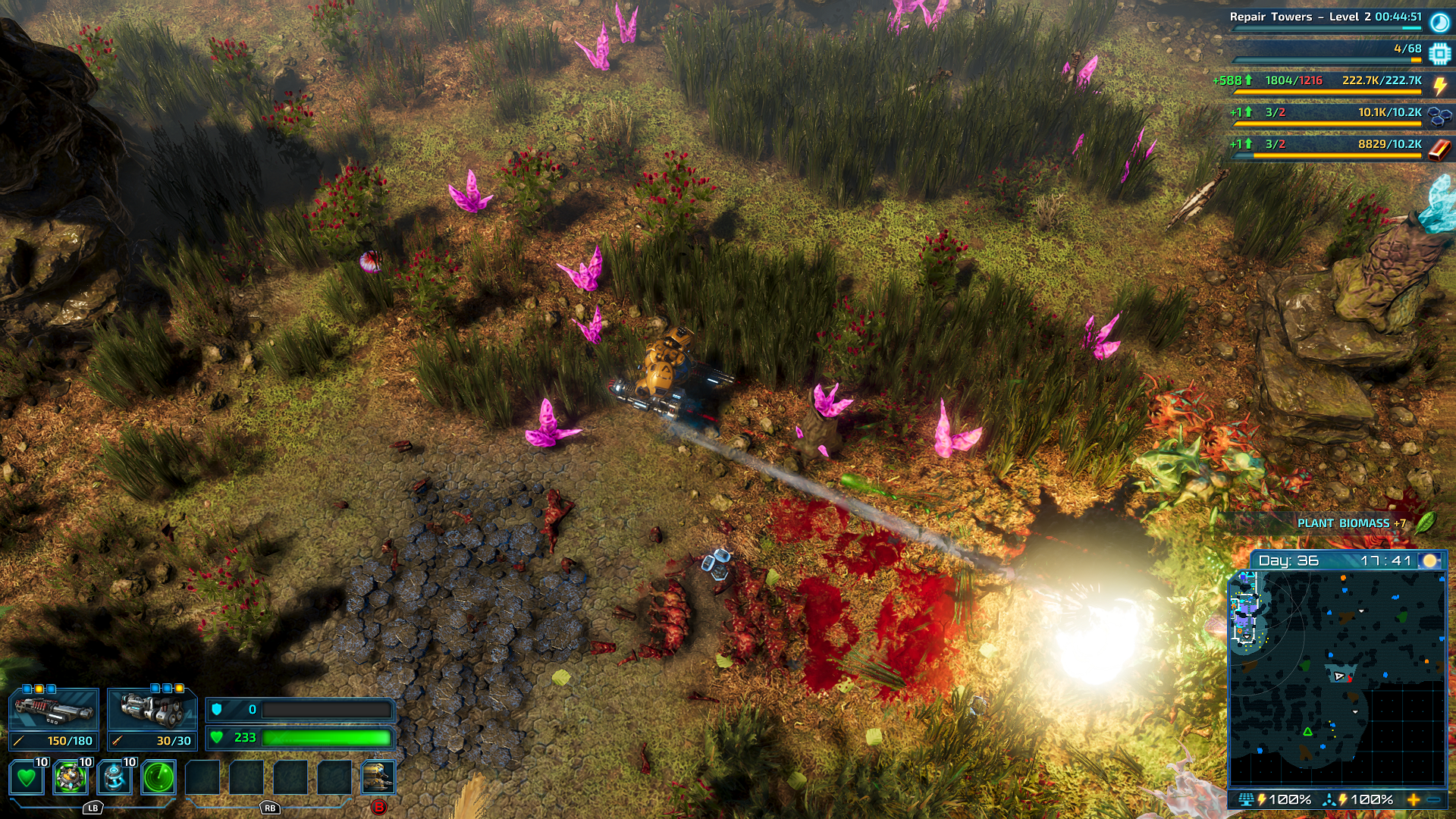
It is impressive how well each element is handled and the level of polish that is seen on all of the mechanics. That said, this is a game that was clearly designed with mouse and keyboard as the controller interface has a lot of different inputs that must be mapped to a limited set of buttons. A good job is done but it means placing walls can get fussy and alternating between building and combat takes multiple button presses.
The story, however, fairs a lot worse and the intent is not clear. Ashley talks of researching the planet and being curious about what is going on out there. The problem with this is that every verb, except one, is about killing and exploiting the resources of Galatea. At one point Ashley muses ‘why are these creatures so aggressive?’. To which, my response was ‘maybe because you are murdering them in droves?’. It is a strange disconnect and one that the game doesn’t really reconcile. This isn’t helped by the fact that this line is repeated over and over again.
Riftbreaker’s final problem is that after about 10-15 hours it is unable to hide the grind. Certainly, the environment changes and the threat increases, but I was still waiting for a number to go up before I could build something and then wait for numbers to go up once more. I feel like fans of Factorio and Stardew fans will be in for a treat but others are going to struggle to motivate themselves to continue.
Conclusion
For people that love Stardew Valley and wanted to see it collide with a kaleidoscope of other genres with a Sci-Fi coat of paint are in for a ride. For those that shudder at the sound of the words ‘Stardew Valley’ avoid.

This game was reviewed based on Xbox S|X review code, using an Xbox S|X console. All of the opinions and insights here are subject to that version. Game provided by publisher.