Reviewing this game makes me feel bad. When I played its spiritual predecessor, Vambrace: Cold Soul, I remember thinking it was a pretty but generic rip off of Darkest Dungeon with not enough to really distinguish itself in that field.
Well, a monkey paw curled one finger, and I got Vambrace: Dungeon Monarch as a follow up.
So, I’ll start with the story – wait, no, I can’t do that because the story wasn’t particularly well translated and during the tutorial it was screeds of text that I didn’t actually pay much attention to. Something about Archon hunters and gods and flashbacks to… something? It is a lot of waffle with none of it being particularly gripping and when I did read some, the text is full of the kind of poetry that I am thankful most people left behind in secondary school. My favourite is when a written part that is supposed to indicate a pause in a conversation just says ‘Silence’. Truly, I understand now why the ellipsis was so much more popular.

I tried looking up the plot, but I just got a website that reiterates what is on their Steam page. If anything, I found the long, drawn-out conversations in the Story Mode between a Skull Lady, a Vampire and the Monarch to be a detraction from what was interesting about Dungeon Monarch – and that was that it seemed like it was trying something new in the genre of deckbuilding.
What it attempts (and almost succeeds) at is a melding of turn-based RPG, Autobattler, tower defence, and deck-builder.
Each level is set up on a grid of hexagons with the enemies trickling down towards the main base. The player starts off the first round by buying from a pool of units, spending gold to get them.
Each unit has a plethora of different values – defence, attack, speed, etc. – as well as special abilities that trigger after a number of rounds of fighting, and a behaviour modifier that dictates whether they will remain stationary or chase after enemies.
Before the first wave of enemies arrive the player can place these units anywhere on available hexes (with the exception of a couple on the side) with the following restrictions – there can only ever be 3 friendly and 3 enemy units on a hex and the player has to adhere to an army size number. More powerful units generally have bigger numbers so it is important to balance armies with weaker ‘cheaper’ units.
Once the units are placed, the enemies start coming in and if they do not get stunned, they will make their way towards the nearest defender and get locked in for a fight. Once all units have moved (friendlies will move to block attackers if their behaviour allows for it) the next phase starts in which the player draws from a pool of cards and decides where their hero unit will land to support their troops.
The cards have a wide range of effects – they can do damage, buff units, capture enemy units and even change the movement behaviour of friendly units – and need mana to be cast. Where Dungeon Monarch differentiates itself from other deck builders is that there are some cards that can only be played if the hero unit has descended to the battlefield but also the hand is not discarded between rounds. This means that there are times when not playing a card is a choice to improve more effective plays later.
The hero unit does damage when he descends so it is good to use him to back up hexes that are struggling. That said, he has his own health pool and if that hits zero he will be taken out for 3 rounds before he can be deployed. This means key cards will be unusable as well. Learning when to retreat a hero to avoid big hits is key to successful defence.
After the card playing phase ends the Autobattling starts. Each hex plays out with faster units going first, and opponents are selected based on how high their priority rating is. There is only one round of trading blows before the cycle starts again – unit placement and movement, card and hero deployment, and then fighting. The special abilities power up for each attack a unit does and these can be truly devastating with some later units able to impact the entire grid, while others provide healing and support.
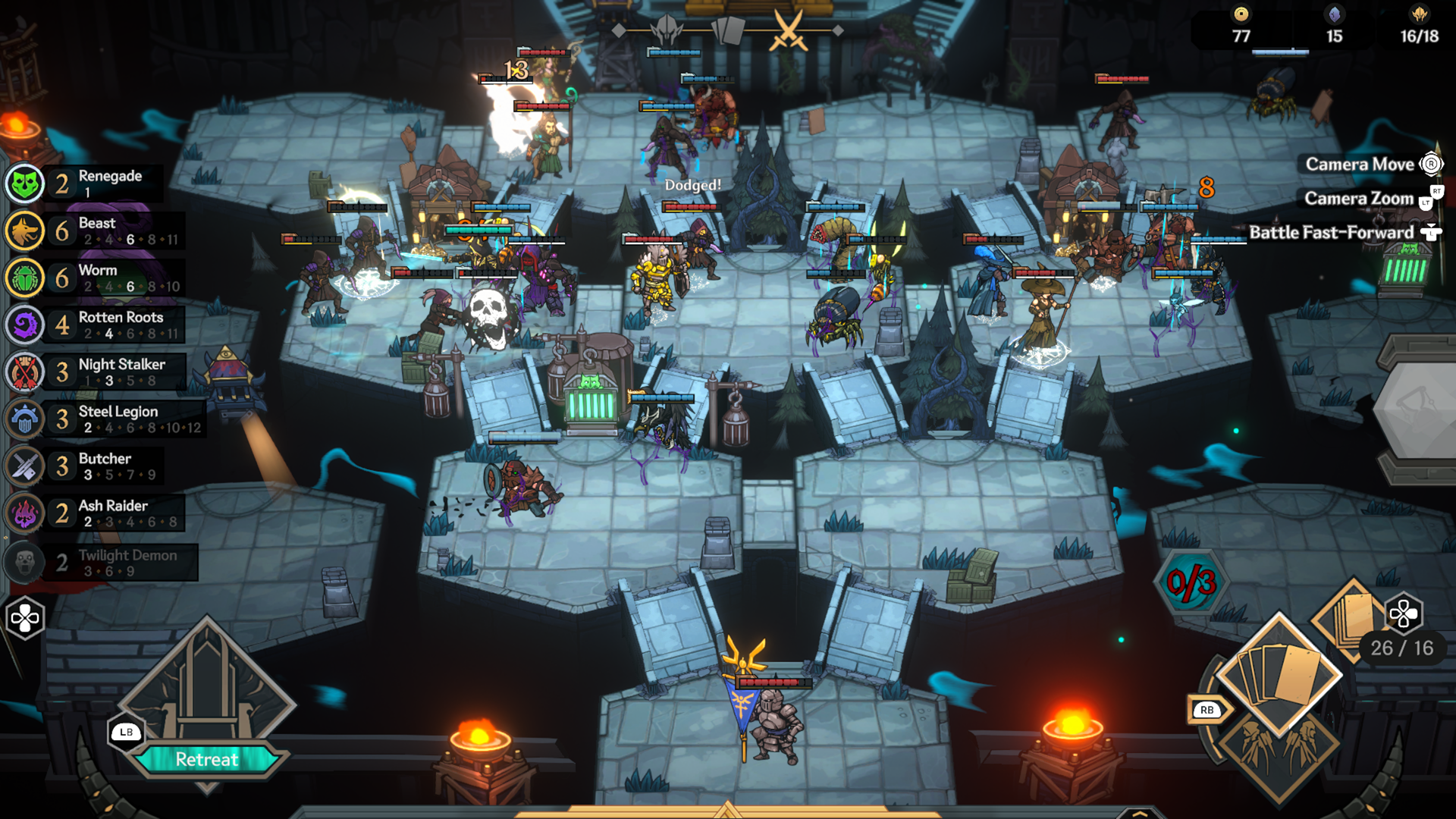
A very neat trick here that is not explained properly is that if all enemy units are killed on a hex the hero is placed on, he will automatically retreat and can be instantly redeployed to another hex. Normally, the player triggering a retreat manually would mean one round cool down. With the ‘all enemies dead on hex’ rule it means that it can be possible to target weaker hexes, kill all enemies and redeploy multiple times during the card/deployment phase and clear grids of a lot of threats in one go.
The player wins by killing all enemies due to spawn, and loses if their main portal is destroyed.
I am not going into the more complex cards that can create synergies for the friendly units, or the ones that change the grid to different elemental affinities, triggering even more complex abilities – but rest assured advanced strategies exist.
I will give one example to illustrate the system’s flexibility: in one part of my playthrough I relied on very weak, low cost, undead units to slow down enemies’ advances. I filled my deck full of cards that detonated these weak units while simultaneously doing massive damage to enemies. I combined this with a ‘gravedigger’ unit that automatically revived undead units on the same hex as it. The result was a lot of corpses exploding.
If this all sounds like a lot, it is. The sheer amount of information that is available for the player at any one time can be overwhelming. The thing is, Dungeon Monarch doesn’t stop there.
For every enemy defeated you collect gold, and a successful win means that the player can select from series of faction cards. Vampires give a lot of buff and life steal cards, Succubae are mainly around increasing synergies and capturing enemies, Golems have defensive cards, and so on. After picking the cards and bonuses the player will then be able to customise their deck, build buildings on their grid, and level up their different factions.
A player can delete any card they like, free of charge, but depending on how they are using their deck there might not be any reason to. My rule of thumb was to just remove any cards that I consistently found in my hand and never wanted to use.
Buildings allow chance for access for better units when placed, and some will be able to create stat increases, others can hobble enemies by making it impossible for them to dodge attacks.
The levelling up the factions involves sacrificing units to upgrade them. Later in the story mode it is possible to collect captured units, some are really powerful but don’t get the same stat boosts from synergies so sometimes it is better to dump them straight into the upgrade pool.
Right, so that is a thousand words to describe everything, if you are feeling exhausted after all of that, I think that correctly emulates the feeling of playing this game. The first two times I attempted to play the story mode I got a thorough paddling by the first boss in the game.
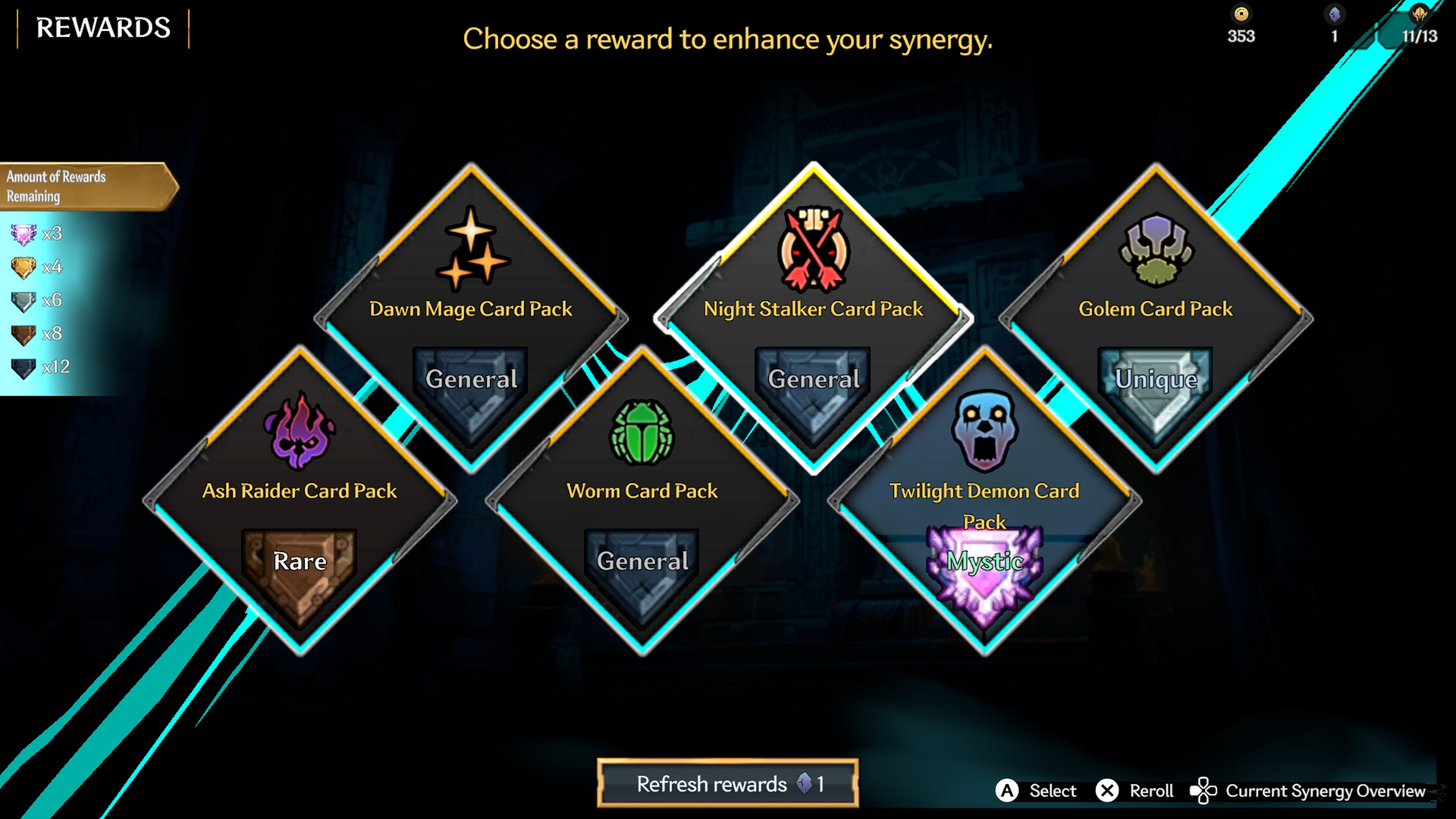
Initially, there was simply too much stuff to take into account, too many strategies not really explained or encouraged. For example, I felt like the game should stress that if you are not having your hero descend every time it is possible then you are doing it wrong. It would be good if it properly explained what SP is (I am still not confident I know what it is) and a clearer idea of how to get synergies and what they do would be great (they increase damage and health of certain cards and units… maybe?)
I think this part is going to appeal to some of the sickos out there – the bewildering array of options and the sheer amount of micro-management that can be done to get through the early stages will have the stats guys in love. However, once I had figured a couple of basic concepts, I actually found that I didn’t have to go much deeper. I’ve now finished both parts of the story mode and I still don’t know what a lot of things do, and the game never ended up pushing me to learn. It is perplexing that game can be so intricate but, also, somehow shallow?
This is not helped by the user interface being overly fiddly and, sometimes, broken. There are a lot of clicking down on thumbsticks to get to features and then sometimes the pertinent information doesn’t appear. I’ve selected menu options that then leave me on a blank screen that required me to reload my save.
With all that said, there is stuff in here that clearly got its hooks into me, I spent an entire weekend fighting my way through the hordes. There was an element of satisfaction to seeing all my units moving around to figuring out how to get my hero drop in on 4 different hexes in one phase and kill 8 enemy units, and sneakily capturing super-powerful enemy units to add to my retinue.
Confounding game.
Conclusion
Vambrace: Dungeon Monarch is a really interesting attempt at doing something different with the deck-building genre. Frustrating, absorbing, annoying, engrossing, very fiddly, but also not as complex as it seems. Fascinating game, that I hope gets a refined sequel.
This game was reviewed based on Xbox S|X review code, using an Xbox S|X console. All of the opinions and insights here are subject to that version. Game provided by publisher.