

I have been chasing the compulsion of Heroes of Might & Magic for decades now. The way that nights turned into days while moving my little hero around with their armies, levelling up like an RPG character but fighting like an Turn-Based Strategy, was intoxicating. No game has really come close.
I had a cursory knowledge of the Spellforce series’ existence but had never delved into it. For this review consider it to be the views of a neophyte. I’d seen the recent games on the store, and it was scratching that Heroes itch, and jumped on the chance to see if I was right.
Spellforce’s premise is that you are an apprentice, your master has gone missing, so you take over his wizard tower, summon up an army and then go investigate. There are three disciplines that the player can choose from: Necromancer, Alchemist and Artificer. They have different starting abilities and troops they can summon. The art is very pretty with the pastels of the world being reminiscent of a fantasy map, and all of the characters have personality and distinct look to them.

Most of the actions take place on the overworld map where the player will move their armies (often commanded by a hero) across hexes to get to objectives. There will be events where the player has to make choices like intervene in a conflict in a village, or give chase to some marauding Orcs. There are also outposts to capture, and the tower itself to upgrade and increase research. Obviously, there are encounters that will trigger combat and then Conquest of Eo switches into turn-based combat.
The rhythm of combat has its own flavour – different from its closest inspiration Heroes. For starters, the battlefields are far more diverse with terrain impacting strategy heavily. Each unit has a set number of action points that can be used to move, attack, defend, or cast spells. The range of armies go from brittle undead archers, to towering Ogres. What makes it interesting is that action points on units can be exhausted by forcing them to return attacks. So, lining up a heavy tank to hit another enemy, means that they cannot retaliate on weaker units, nor move during their turn. This simple twist is a good one and changed how I thought about combat.
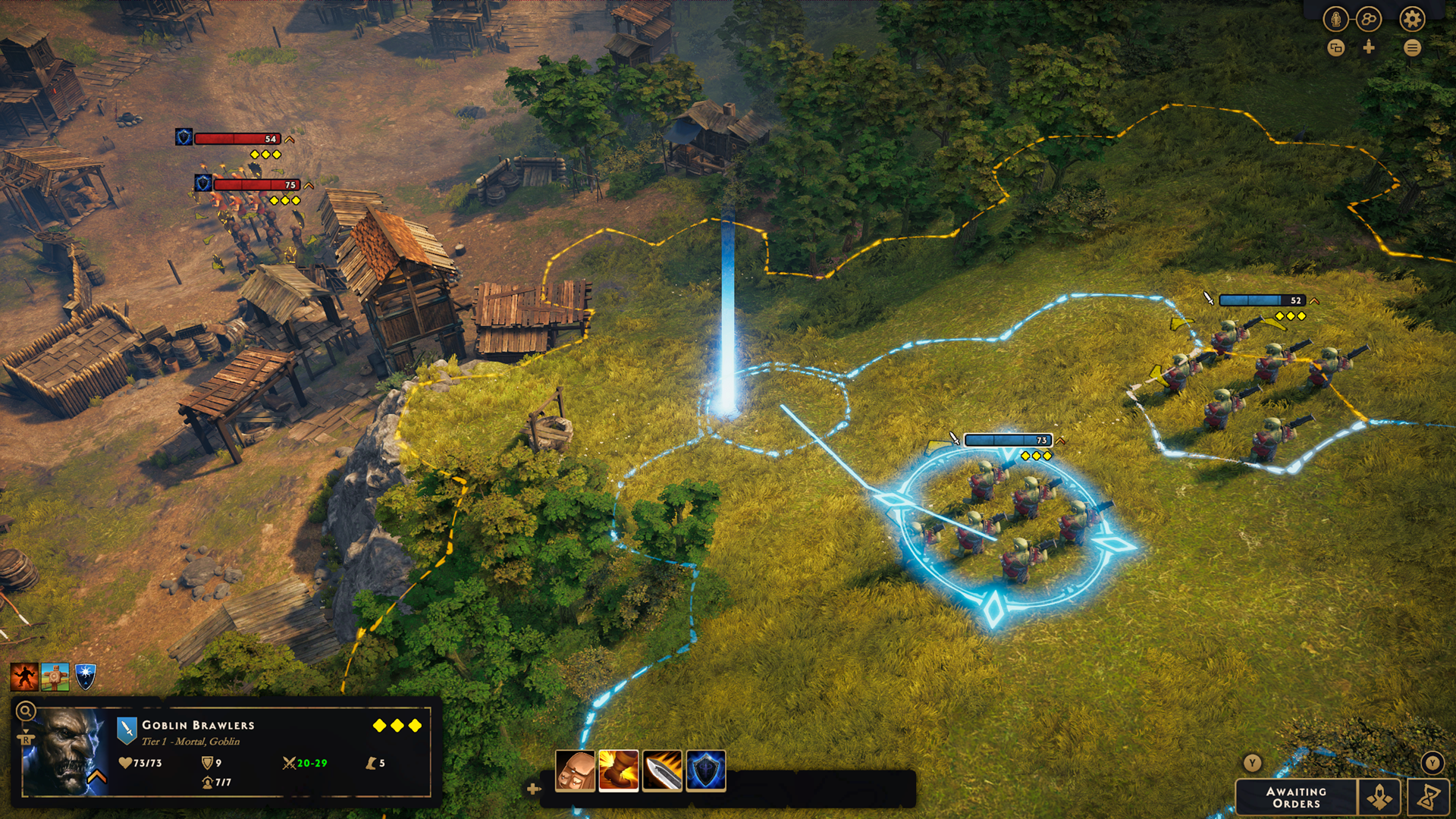
After combat, units will level up and have their own skill trees, with heroes offering more stats and variants on tactics. There is a lot of things to tinker with here and exploration is deeply satisfying. I will say that as a newcomer, there was an awful lot of information thrown my way in the opening turns and I found myself a little overwhelmed. The good news is that Conquest of Eo gave me plenty of time to adjust and figure out what needs to be done next.
This is good, because Conquest of Eo is huge. The campaign stretches over a massive map and the quests seem to be never ending. I love that the tower itself eventually gains the ability to fly, making it so that units don’t need to make long treks back to base.
Again, as no proper expert of the franchise it is hard for me to talk about Conquest of Eo’s strengths and weaknesses in regard to the rest of the games. I will say that my experience with it was very positive with the game offering a lot more variety in outcomes than some others in this genre that I have played. The combat stays fresh, and the auto resolve seems very fair in the fights where the player is clearly going to win.
For those curious to relive some of the HOMM days, Conquest of Eo seems a good place to go.
Conclusion
Conquest of Eo, to a newbie such as myself, was deeply accessible with a ton of good variety in its combat, exploration and scenarios. It is a strong recommend for fans of the RPG/Turn-based strategy hybrid.
This game was reviewed based on Xbox S|X review code, using an Xbox S|X console. All of the opinions and insights here are subject to that version. Game provided by publisher.


