I first took notice of Okinawa Rush last spring when I stumbled upon a trailer for the game. It was hard to ignore its retro pixel art aesthetic and its frantic, fast-paced arcade-style action. I wasn’t sure if it would come to Xbox, but then it was announced as a fall release. The fall is always a busy time for video game releases. It’s easy for a game to slip through the cracks, especially if it’s an indie. I didn’t have time to review the game at release, but now that the deluge of game releases has died down I have more time on my hands and the Tavern was lucky enough to get a code for review, so I jumped at the chance.
Right from first glance, it’s clear that developer Sokaikan has great admiration for arcade games. The visual presentation of Okinawa Rush is spot on, it really looks like an arcade game circa 1990. It has scan lines and I don’t know if this is intentional or not, but some of the faster movement is a little janky or choppy almost as if the game is mimicking the limited frame rates of older hardware. The pixel art is well done and the overall aesthetic is fantastic. The feudal Japan-themed islands of Okinawa present a unique location for the game to take place, and there is a fair amount of variety in the levels although there are only five of them.
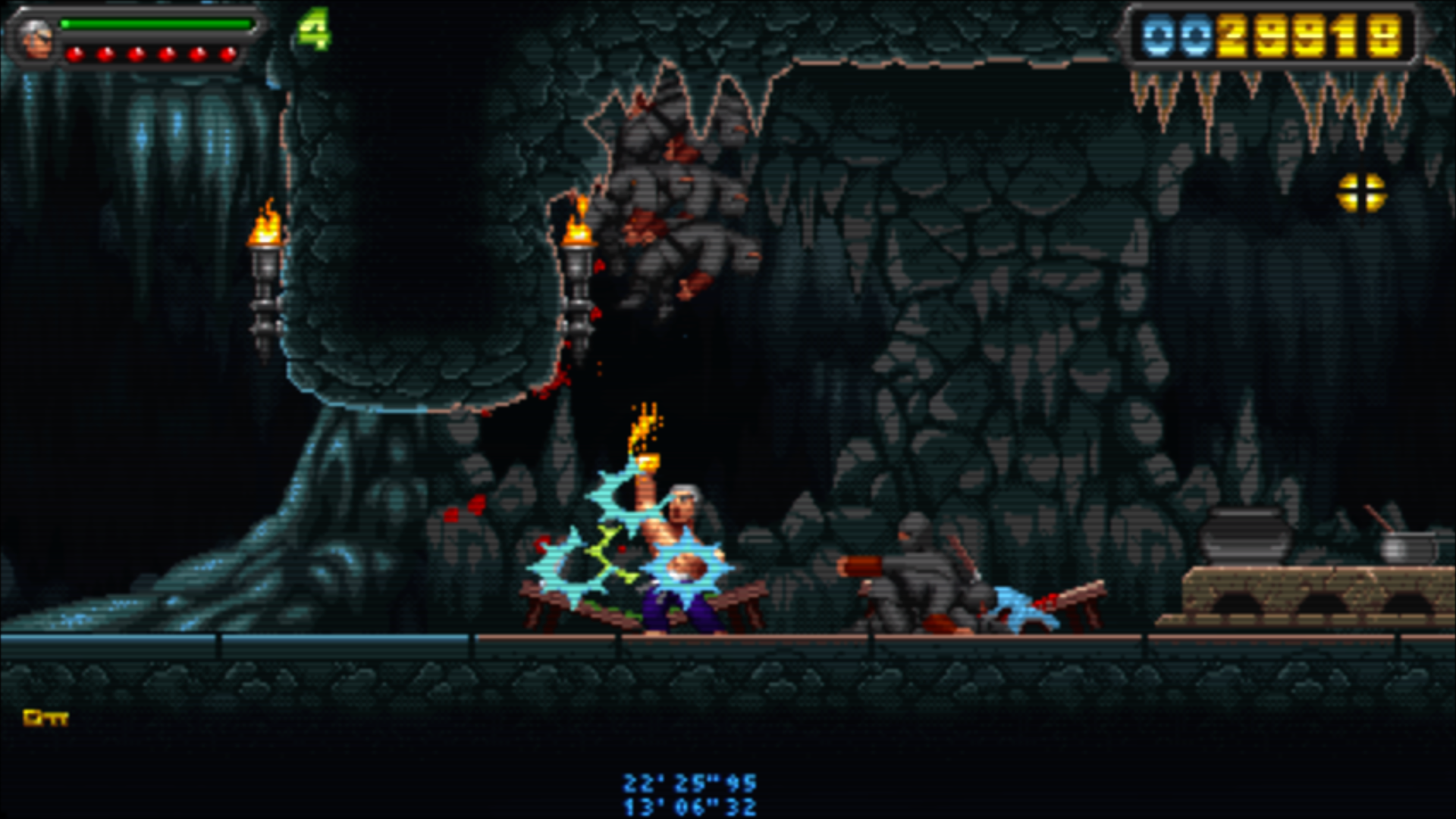
Okinawa Rush might only have five levels, but there is a decent amount of additional content in the game. There are three playable characters as well as local co-op, which really bumps the fun factor up a notch; however, the camera only follows the first player so the second player can run into issues if they go out of view. Each character has their own story but they all intersect to varying degrees. The main character, Hiro, is on a rescue/revenge mission to save his children and stop the evil Black Mantis Clan. The leader of the clan, Lord Mantis, killed Hiro’s wife while trying to obtain the powerful scroll of knowledge in the family’s possession. When Hiro returns home he immediately realizes what has happened and sets off on his quest. The first piece of additional content most players will experience will most likely be the prologue chapter that acts as a tutorial, you play as Hiro’s wife while she takes care of some chores just prior to the Black Mantis Clan’s attack. There is also a training area where you can train against live enemies and practice fighting the first boss. It would be nice to be able to practice against the other bosses as well, but unfortunately that is not an option. The training section also gives you the option to play minigames which will improve your stats and finally there is a store that lets you buy decorations for your dojo (which can also improve your stats depending on how you place them in the dojo).
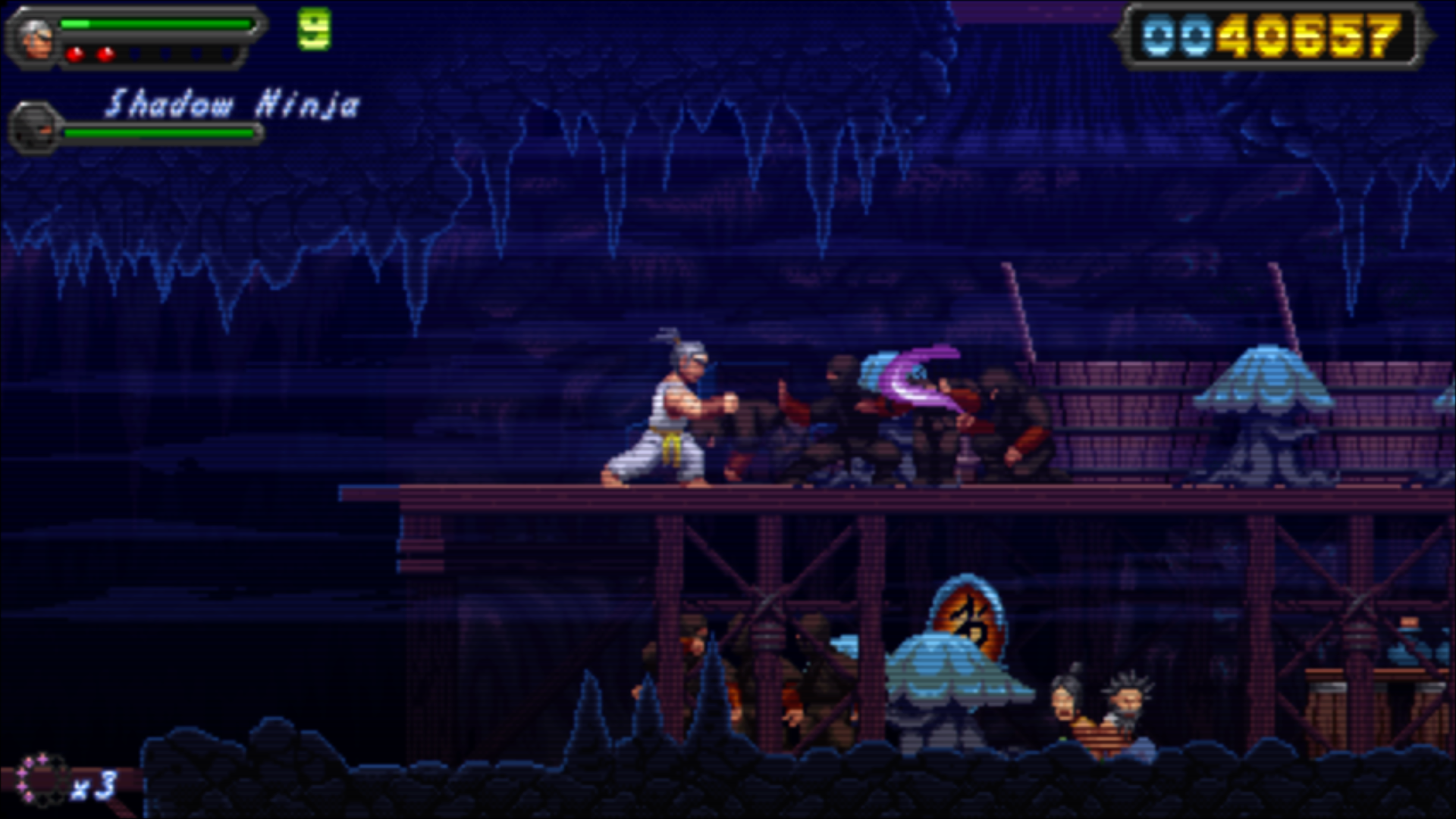
The gameplay in Okinawa Rush is frantic yet fun and fluid. It’s basically a 2D beat-em-up with tons of attacks, combos, grapples, as well as special moves, all of which can be performed by pressing specific buttons, similar to a fighting game. The biggest issue I had with the game, however, is that the attack and jump buttons were swapped in the default setting (set as A for attack and B to jump). This is one of my biggest pet peeves, sometimes I wonder if developers actually looked at an Xbox controller when porting their game from Steam or Switch. The game does have button remapping options, which I suppose is its saving grace, but all of the hints and button prompt HUD elements are color-coded in the original default layout, which makes things very confusing while you play if you’ve switched them.
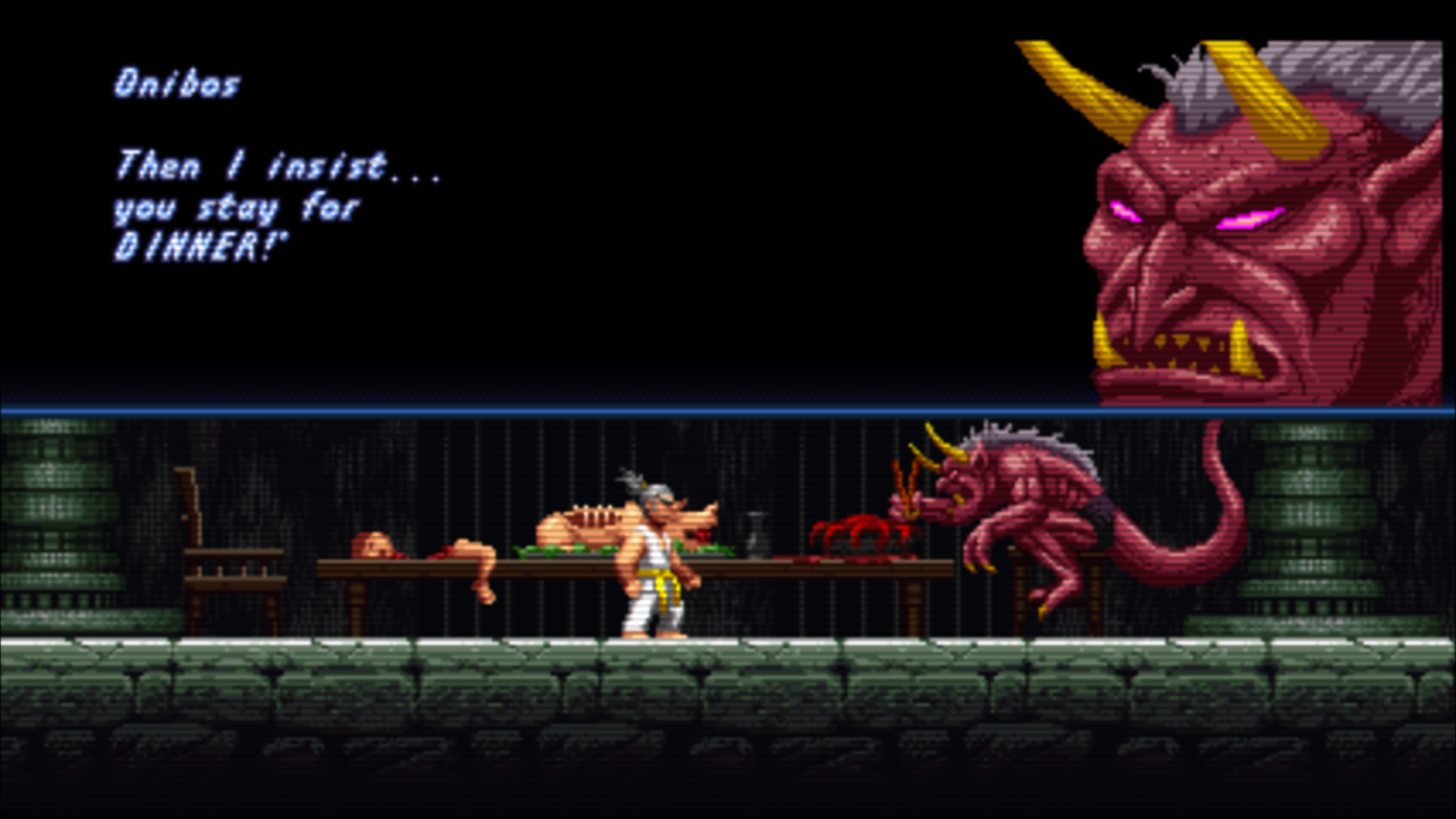
Hiro and Shin’s moves felt very similar, I think they might share the exact same moves list. The third character, Meilin, has her own unique moveset which I thought added a nice bit of variety to the game. Each of the three characters also has different starting stats, some start with more health whereas others might do more damage or are better at blocking. I’ve never been good at memorizing move lists (perhaps this is why I’m terrible at traditional fighting games), but I was able to get by with the basic moves and a bit of button mashing. I think players that crave a combat system that’s more intricate than the average game will greatly enjoy the action in this.
There are two gameplay modes in Okinawa Rush: Story mode and Arcade. It’s recommended that you start with Story mode as it has a large number of difficulty settings represented by Karate belt colors – there are also roughly a half dozen additional difficulty settings that are even harder than black belt. Story mode makes use of a lives and continue system as well as checkpoints, which you will respawn at if you have any remaining lives. If you run out of lives and continue then you will restart at the beginning of the level. When playing the lower difficulties such as white and yellow belt you will be able to find plenty of extra lives, which are illustrated as small green circles. Some are out in the open whereas others are hidden. Each level has a ton of secrets, and while the levels are linear they have an open feel to them because of the alternate paths littered throughout. Most paths/detours have some sort of reward at the end so exploring feels worthwhile. One other benefit of the story mode is that you can select any of the levels to play, as long as you have beaten the previous level.
Arcade mode is very tough and intended as the true challenge for players who are familiar with the game and confident in their abilities; because of my lack of ability I didn’t spend much time in this mode, I threw in the towel after dying repeatedly in the first stage. There are two reasons for the spike in difficulty. First off, you have a limited amount of lives and I wasn’t able to find any extra. Secondly, there is a timer that results in a game over if it reaches zero. You gain a little more time for each section of a level you complete, but you always need to keep up the pace.
Okinawa Rush features a fantastic soundtrack that matches the intensity of the on-screen action perfectly, it’s fast-paced and contains a mixture of rock music and Japanese-style sounds. The sound effects in the game felt like they overshadowed the music at some points but that was alright because they are also well done. When facing large hordes of enemies the sound effects really up the tension and excitement, sort of like an audial reward for you playing well. The game also uses a few different “KA-CHING” type noises for when you pick up items that give you points. The best aspect of the sound design, however, is the voice work for the story. All of the dialogue is fully voiced, and I was pleasantly surprised when the voice came through my headset during the first cut scene.
Conclusion
If this game was released on SNES when I was a kid I have a feeling I would have sunk an endless amount of time into it, especially with the fact that it has local co-op. I know I would have worked my way up through each difficulty setting and tried to find all the secrets hidden in the game. The game contains a nice variety of content overall, but I think featuring only five main levels is a little slim; however, I did have fun during my time with the game. If you have a local co-op partner then this game should definitely be on your radar. If you prefer to play solo then this could appeal to you, if you like challenging retro-fueled experiences.

This game was reviewed based on Xbox One review code, using an Xbox One console. All of the opinions and insights here are subject to that version. Game provided by publisher.Want to keep up to date with the latest Xt reviews, Xt opinions and Xt content? Follow us on Facebook, Twitter, and YouTube.