God of Rock aims to meld one on one fighting action with the rhythmic gameplay of Parappa the Rapper – an idea that, on paper, sounds pretty good to us. However, while there’s fun to be had in the product at hand, we can’t help but come away from it far less enthused than we’d hoped.
You see, each of the respective genres are obviously well versed in many fantastic titles already available, from the aforementioned Rapper to countless Street Fighters, Guitaroo Man, and more. Dedicated fighting game players may even compare their average bout to a session of Guitar Hero in the need to feel the flow of the fight and respond with perfect timing akin to hitting a perfect guitar solo. And so, this mash-up feels like it makes all the sense in the world. Indeed, there’s moments playing God of Rock that almost live up to the promise we’d hoped for, but there are equally moments where it doesn’t.
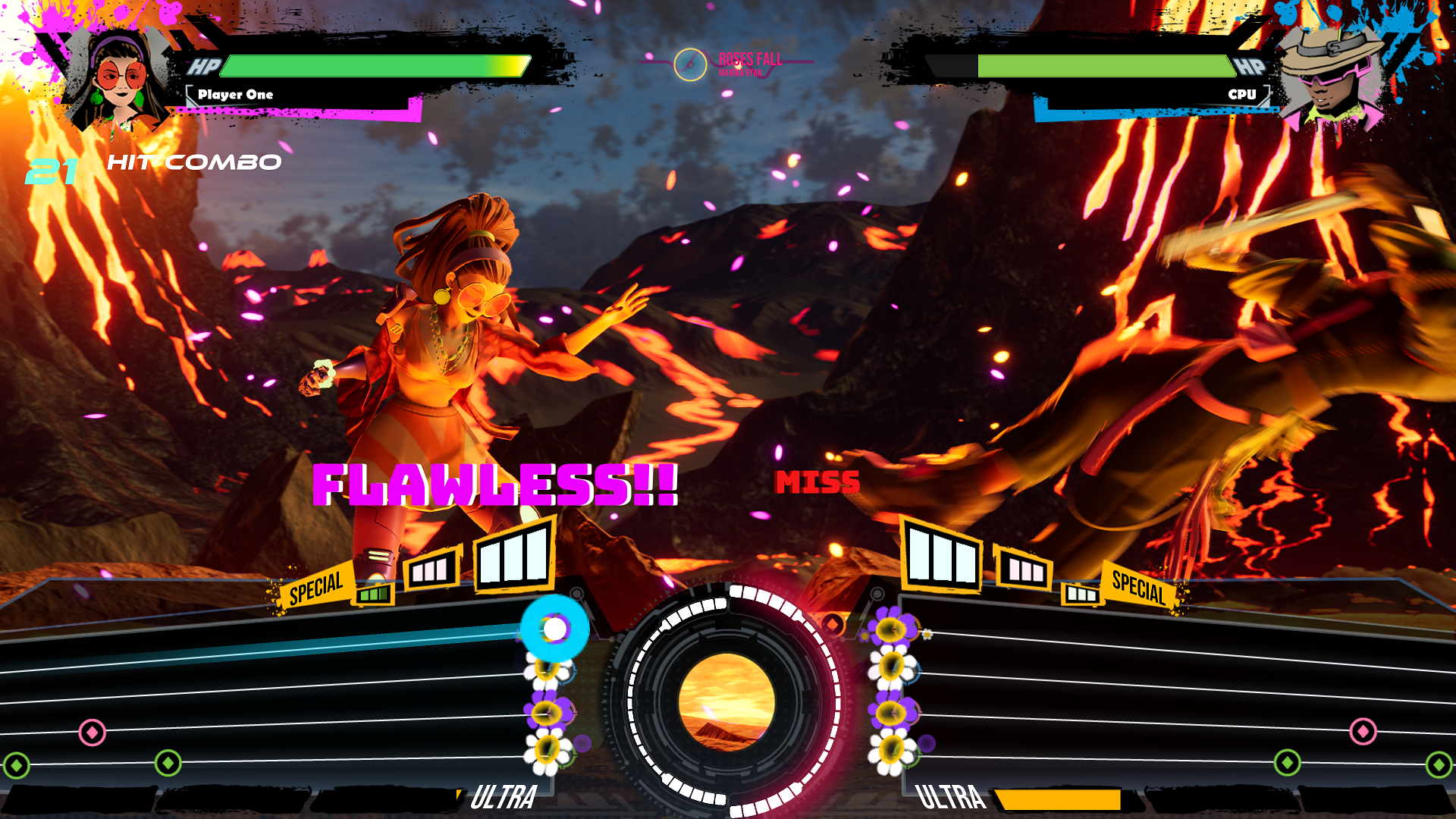
The boiled down explanation of God of Rock’s gameplay is simple to get across: two players go head to head in battle, only instead of combo strings and frame parries, we must beat match a scrolling track of button inputs in the vein of Rock Band, with better timing offering stronger attacks or blocks. Bouts start off easy enough, with relatively few inputs, though it’s not long at all before we’re really put to task with button combos flying along at breakneck pace.
It’s simple to grasp, but very hard to really get the hang of. We’re big fans of rhythm games here (and if we do say so ourselves, not too bad at them generally), and we found ourselves finding our groove somewhere between 20 seconds to a minute. The early parts feel very slow to get going – intentionally so, to give fighters chance to warm up – but if a fight drags on much more than the minute or so things get frenetic in a bid to see a winner. It’s a good if not perfect way to ensure players aren’t stuck in a fight for too long. Each of the characters also has access to a special meter, which allows them to perform extra special attacks or defensive flurries.

Where we struggled was putting everything together in the thick of a fight. See, the main beat track uses the ABXY buttons, but these are laid out in a vertical line with the upcoming inputs scrolling from the side our fighter is on. We’re very accustomed to where the buttons on the controller are by now of course, but having them presented this way on the screen still managed to trip us up, especially when fights reached their later moments and we’d need to press two buttons simultaneously that were opposite each other on the pad (X+B, or Y+A). Going for the Guitar Hero-style fret board look has never really fit using a gamepad to control, and it’s no different here.
And those special moves? Well, we must also memorise more traditional fighting game directional inputs that all finish off with a pull of one of the triggers. They’re not much more complicated than a hadouken-esque quarter/half circle flick, but trying to do this at the same time as beat matching with the face buttons proves tricky. We also have a simpler defensive move on LB that is used to reverse a special attack, but this is limited to the gauge we’ve built up and depletes quickly.
We feel that these tricky control elements could be overcome by a dedicated player mind you, and if this hits the right person there could be some impressive feats of dexterity to be seen.
However, after clearing the campaign, doing some extra fights, and a handful of online matches, we found ourselves drifting away from God of Rock thanks to, well, a lack of memorable songs to play to. Part of the appeal of previous rhythm games in naturally in playing songs we know already, or – in the case of Guitaroo Man – having a band come up with a dedicated soundtrack of absolute bangers. God of Rock’s selection of tunes is expansive but fairly dreary, with hardly any of the tracks we played catching our attention, let alone becoming earworms for the next few days. They’re more reminiscent of the kind of backing tracks in arcade brawlers, the kind you know are there but aren’t really paying attention to because all you can hear is the thuds of fists on faces. It’s much the same here, with the music drowned out but punches and kicks, and a sharp cymbal crash on each successful button input. And thanks to the way the difficulty increases gradually, the button tracks don’t even line up with the music especially well, chopping and changing what instrument or rhythm they’re following throughout.
We’re afforded a chance to try our hand at song creation though in the custom track editor. Here, we can place button inputs for one of the songs and make our own rhythm It’s a surprisingly detailed editor, going from 4/4 time signature all the way to 64th‘s if we really want to make a thrashingly difficult track. Again, dedicated players will no doubt use this to really challenge their friends.
God of Rock’s main obstacle will be finding those dedicated players though. Much like any other fighting game, this is far more enjoyable when playing against human players, ideally locally, but this is just on the wrong side of pick up and play that will prevent those who aren’t invested in learning tracks and getting better from wanting to play more than a few rounds.
Conclusion
While the idea is novel and decent on paper, God of Rock left us wanting thanks to a tricky learning curve and music that fails to inspire replayability.
This game was reviewed based on Xbox S|X review code, using an Xbox S|X console. All of the opinions and insights here are subject to that version. Game provided by publisher.