

A few years ago, I wrote about Jusant. At the time, I detailed how it intersected with the history of climbing and how the mechanics represented the experience of fighting with a puzzle wall. I called it the gold standard of climbing games.
I am not rolling back that statement after playing Cairn, but where I think the two games differ is that Cairn seems preoccupied with an aspect of the activity of going up big rocks that I tend to not write about, and only discuss in person.
I think every sport suffers from this – that those who are the very best in the world have to be people who are a little bit mentally ill. I don’t mean this in a ‘might be able to do some therapy and work through the issues’, I mean it more in the ‘unable to feel anything unless they are putting their body and soul on the line’. Climbing is probably the most stark example of this because one minor slip, or mistake, could be fatal.
You only have to search online for ‘climber dies’ and you’ll find a high-profile story about the death of a climber from a few months ago. An excerpt from this report is the problem I have with this (emphasis mine):
“‘He’s had probably one of the most impressive last six months of climbing of anyone I can think of,’ veteran alpinist Clint Helander told the Anchorage Daily News in July.”
For anyone who has followed the top climbers over the last 10 years, that line is very familiar: climbers consistently achieve incredible feats and push themselves even further, and then die. Every report is about them breaking records and not really examining why exactly this might not be a good thing. There are these celebratory documentaries like “Free Solo” and “Dawn Wall” about how these singular people are taking on what seem like impossible odds and overcoming them. When I watch those documentaries it makes me deeply sad, because what I see are people that are unable to trigger happy chemicals in their body without being near death. You don’t cheer on the addict; you get them help.

It is a difficult topic to do justice. The term ‘adrenaline junky’ conjures up happy-go-lucky bad boys (and girls) in films. It’s even harder to communicate the kind of duress that a person has to put on their bodies to accomplish these sort of things. Of the media I’ve seen cover this aspect of climbing, I think Cairn has come the closest – both through the mechanics and the storytelling.
It starts off with the protagonist, Aava, and her trusty belay robot in a rock climbing gym. This leads comfortably into learning the system of climbing, which has the player controlling one limb at a time and moving it to find a hold. Once locked in, the game will automatically shift to another limb and the player must move that to a new spot, taking into account Aava’s position and how much pressure she can take. It sounds complicated, but I found that after about 10 minutes I’d gotten used to the rhythm of methodically looking for hand and footholds, balancing my weight, and getting up the training routes. The difficulty slowly ramps up until Aava climbs out of the gym and is faced with the mountain.
Despite some of the rubbery animations, which seem necessary for the freedom of movement, there is an authenticity to the climbing. Whoever set up the logic around it understood the ideas of side-pulls, pinches, bridging, matching, and the logic of thinking about a beta (although everything is pretty much static routines with no opportunities for dynos). For those who do not know what those terms mean, you don’t need to – just know that this feels like the real thing, most of the time.
Climbing out of the gym and seeing that mountain for the first time is an awesome sight that gets at the reason why climbers do what they do, and what motivates us to try and climb stuff. It’s not just the stress and the challenge but also what you will see if and when you get to the top.
The first thing that struck me is that it is possible for Aava to start climbing anywhere that she can walk to. It is down to the player to scope the route for where they think it’s best to ascend. Although the paths are probably limited to prescribed developer routes, there is the same sense I get when I look up at a real climbing wall and my mind starts to calculate what makes the most sense.
Every hold counts, too: get the right hand holds and foot holds and Aava won’t burn through stamina too quickly. I’m sure that under the hood there is a meter that is measuring the tension, but I am glad the raw stats are not apparent. Instead, when Aava gets into trouble with a poorly judged move, you’ll see her limbs start to shake, hear her start to make alarmed noises, feel the controller vibrate, and the screen colours distort and desaturate. If you don’t reposition her quickly she’ll take a fall.
The sensation of missing a hold and seeing Aava’s arm start to shake, repositioning her, seeing a leg start to go, and then frantically trying to find somewhere to lock-in mimics the real-life sensation of flubbing a climb. There were countless moments during my playthrough where I would scramble to desperately get into place, catching a ledge at the last second, and feel my actual palms sweating in response to the experience. That, or in a final moment of desperation I try to connect with a hold, but Aava’s stamina is gone and she just comes off the rock, screaming.
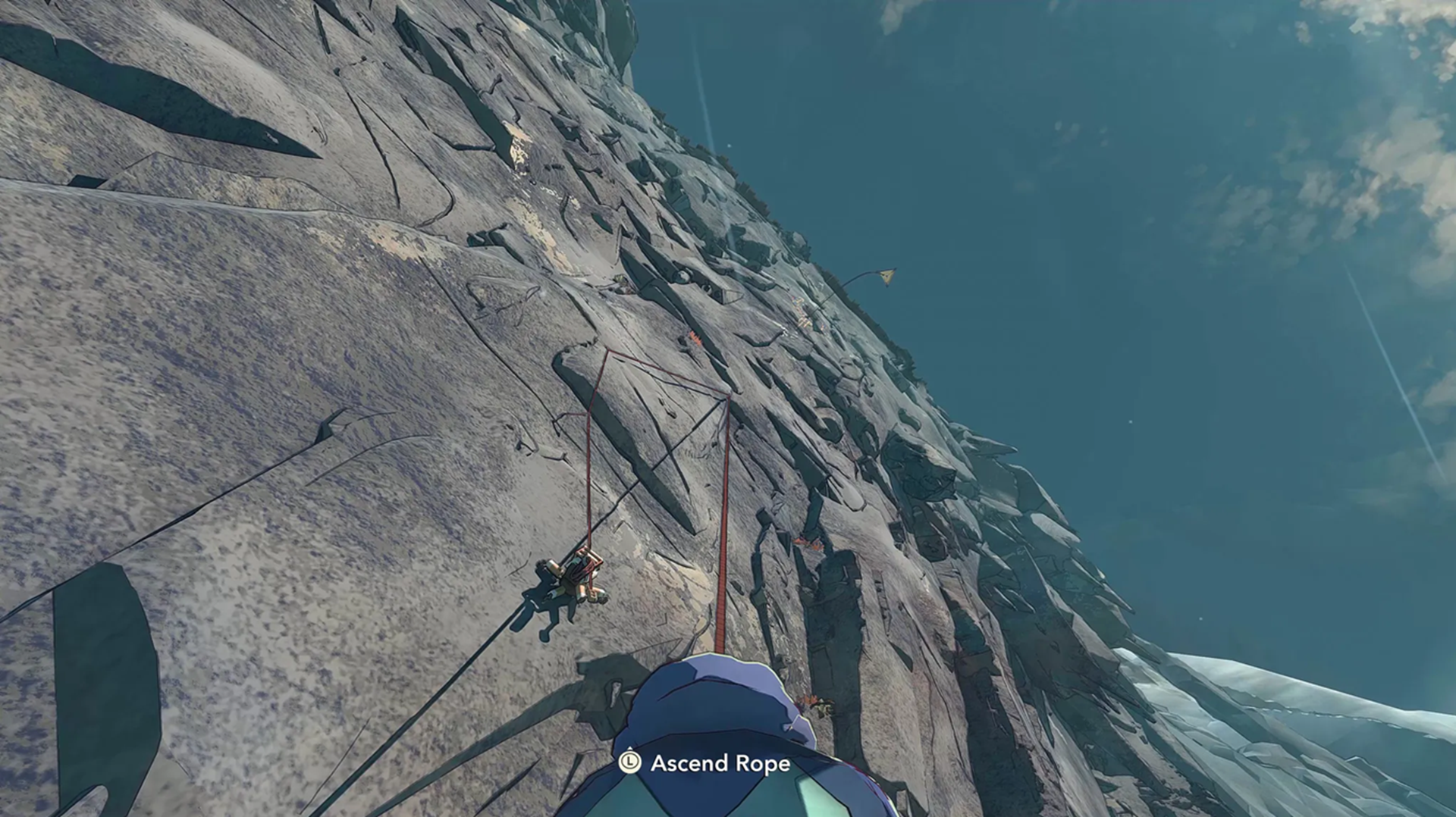
It is not just the stamina that’s a threat; there are survival elements, too, with an on-screen hunger, thirst, and warmth meter. Both hunger and thirst go down over the course of a climb, and these can be replenished by drinking and eating items that can be carried in Aava’s bag. Both food and water have to be collected off the mountain itself. Early on, water is found in abundance, and food can be collected from bear-proof boxes or gathered from bushes. Whenever you reach a save point, it is possible to cook or infuse Aava’s food and drink with certain items for added bonuses beyond regenerative properties. Extra grip, stamina and focus can be gained and these will come in handy during the most stressful parts of the route. Warmth, on the other hand, is impacted by climbing at night or getting into the harsher climes. Getting Aava’s body heat back up requires sleeping at a safe spot (which will diminish the thirst and hunger meters) or consuming hot consumables.
Other than the aforementioned consumables, there are two that will be familiar to climbers who use them to aid longer climbs: chalk and pitons. Chalk has the obvious bonus of making it possible to practically stick to any wall for a limited number of movements, and your supply of chalk can be replenished by recycling trash that Aava finds along the way. Pitons can be inserted into the wall to create resting spots, and also as a safety measure to catch Aava if she falls. Putting a piton in triggers a QTE where failing to hit the cue may destroy the piton, and there’s always a risk of breaking them when they’re retrieved later on. Aava can use two broken piton scraps to rebuild one piton, but as the total number of pitons dwindles she will need to find more, sometimes retrieved from the corpses of climbers that attempted to scale the mountain before.
Many of these important items will be hidden away on perilous but rewarding side paths, as well as bonuses that can be worn or attached to Aava’s back pack. Given the wealth of places I could not explore, I am certain that there are things I missed. The tension of seeing a difficult route across a chasm with a tell-tale warm glow of a curious cave had me weighing up the remaining resources in my backpack against the possible reward at the other end. This, too, felt like Cairn understands what drives professional climbers: you might be making things more difficult for yourself – fatal, even – but the satisfaction of beating a climbing section is tantalising.
The further up the mountain I traveled, the more I had to focus on the main route with no distractions or detours. Food and water started to become more scarce, the wall less forgiving. Even with two indestructible pitons, the distance Aava had to climb ‘off rope’ (risking huge falls) got longer and more perilous. I found myself taking more risks while consistently having to put Aava’s body under more pressure with even more limited reserves. The ascent mimicked what it feels like to keep pushing beyond any natural comfort zone, with sections of the game taking 40 minutes of careful negotiation with the constant threat of a damaging fall.
The story, too, matches the sense of desperation I started to feel, unsure whether I would have enough juice to reach the next save point. Aava starts off monosyllabic, avoiding conversations with her family who are confused about her need to leave everything behind. She talks of a nightmare she has where she will reach the top of mountain and discover that it’s a tourist haven that anyone can get to it.
The people Aava meets that still live on the mountain have similarly bleak stories of isolation. One such story is from a goat herder who hasn’t realised that she now lives alone, abandoned because of displacement as previous inhabitants decided it was easier to live in the city. Countless other alpinists you encounter are just corpses with sad little stories scribbled onto death notes, describing obsessive-compulsive behaviour that has led them to their fate. These dead climbers remind of the haunting rainbow valley on Everest, where fallen climbers are left frozen in time.
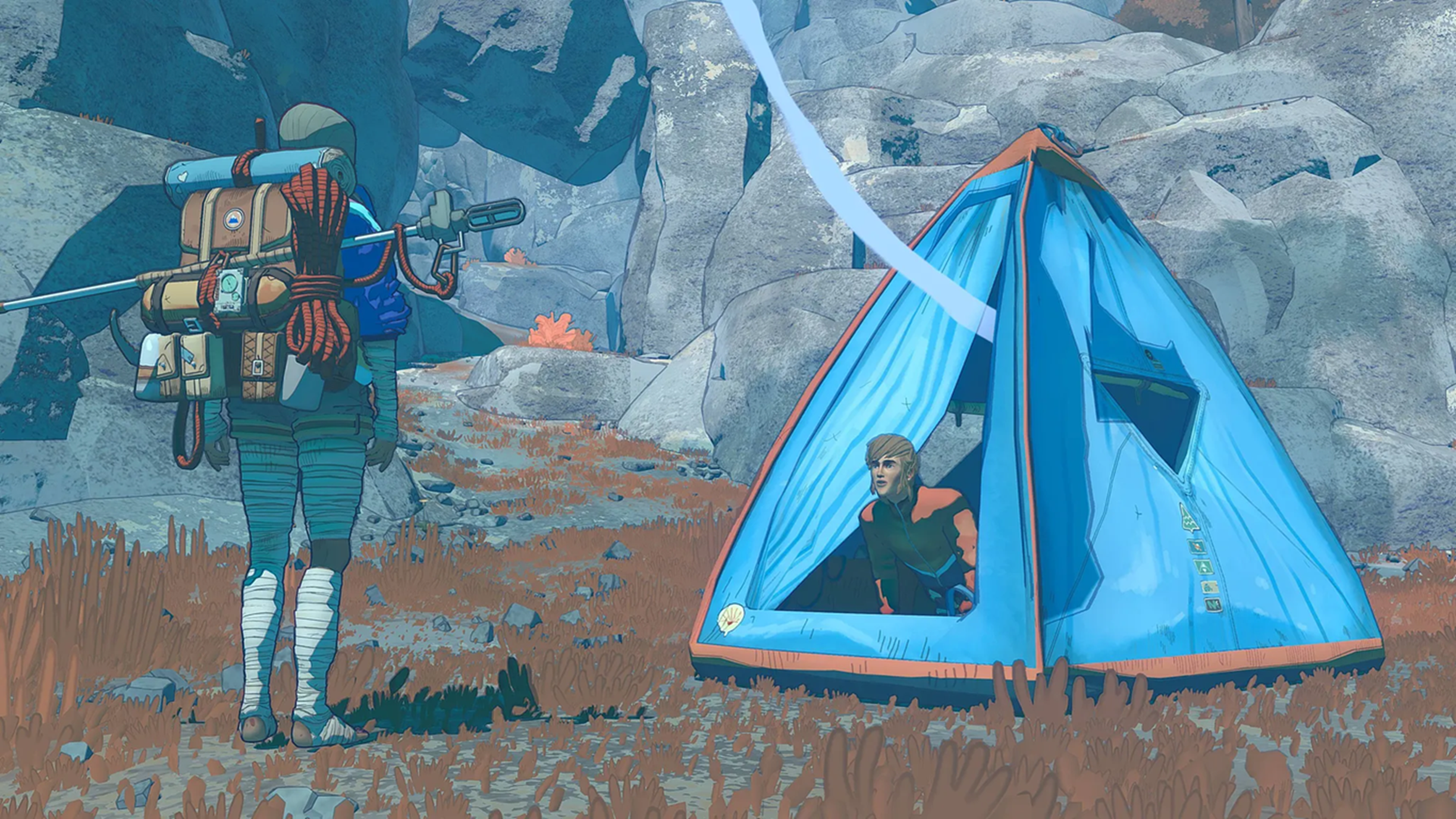
The one through-thread is a younger mountain climber called Marco, who puts Aava’s behaviour into context. While Aava is detached and evasive, Marco cheerfully tries to chat away. Aava goes barefoot and sticks to old fashioned gear, and seems to be punishing herself. Marco is kitted out and comfortable; he isn’t interested in suffering to make the climb.
(If you’d like to avoid spoilers for the story, skip the next paragraph.)
It starts off predictable, with Marco’s effervescence gradually winning Aava over. She opens up a little more to him and they even do a few sections of the climb together. She sees him as a kindred spirit, and it is in those scenes that it became clear to me that the developers understood the assignment. Rather than Marco intrinsically understanding Aava’s need to climb the mountain, he rejects it – he isn’t consumed by the need to do it. Later on, when Marco appears to burn out and give up, Aava smiles at him with the warmth of someone that thinks she gets it. She gives him praise and encouragement that, in weaker writing, would be seen as a triumph of the soul. Instead, when they meet up again later on the mountain, Marco is in a worse state than he was previously. When Aava tries to urge him on again, Marco explains that she is actually making it worse and that it won’t be the mountain that kills him, it will be her. It is such a good moment and a skewering of Aava’s beliefs: she is self-serving when she pushes him. She’s chasing this mountain because there is a part of her that would be content to die there and avoid her other responsibilities. It is a brutal indictment of a climber’s drive. They flub it a little with Marco’s final scene, but that doesn’t detract from what the game’s narrative has said before.
Cairn is an astounding game with a keen sense of what makes climbing frightening and exciting, while also exploring what that means for the people that are addicted to it. I have small complaints around sometimes feeling like some falls weren’t my fault, but even that feels true to the experience of miscalculating a move in real life. This is a game for climbers, but I urge everyone to try it.
Conclusion
Cairn is thoughtful in its mechanical exploration of being a climber and it also delivers a story that pushes back on the mythology of the sport and the people that reach the highest levels. This is an essential game.
This game was tested and reviewed on PC (via Steam). All of the opinions and insights here are subject to that version. Game provided by the publisher.Want to keep up to date with the latest Xt reviews, Xt opinions and Xt content? Follow us on Facebook, Twitter, and YouTube.


