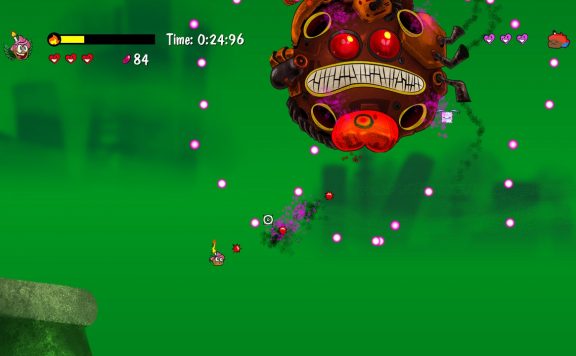
Vampire Survivors was a huge splash when it came out. It was the first time in a long time that a distinct subgenre had come out. People are still debating on what that genre is called (bullethell auto shooter? Survival roguelike shooter?) but it resulted in a lot of imitators that I am going to call Survivors-like because I don’t have an original thought in my head.
Having played a lot of these, the formula is pretty straight forward. They are top-down shooters where thousands of enemies spawn and converge on the player-character. Rather than being able to aim and shoot at these enemies, the character has a starter weapon that fires off on a timer and it is about them positioning themselves in a way that the enemies get caught in the firing arc. The enemies drop experience and as the character levels up they get buffs, and extra weapons.
Most of the games in Survivors-like don’t do a lot to change the formula; maybe it is melee focused, maybe it is wave-based, etc. But none of them have really changed the way I’ve played them. Vinebound – Tangled together makes a stab by making its core a co-op game.
The loop is still the same, top-down, arena, with experience-based levelling system. At specific times, mini-bosses and bosses will spawn and have extra weapons to add to the repertoire. There is also meta-progress that upgrades abilities, weapons and unlockable characters.

The co-op spin is hinted in the name – the players are linked together by a flower vine. This means that if the two ends move too far away they get pulled towards each other, and if they get too close the vine repels them. The length of the vine also dictates the timer, as a flower runs along the length of the vine and when it hits one end it triggers the attack.
In solo play, the player controls both ends with them being mapped to the left and right sticks. There is a real element of ‘patting your head, and rubbing your stomach’ to the system that hit the spot for me in terms of messing with my brain. I did like that they offered some balance by making one end invincible so that collecting the ‘juice’ (experience) wasn’t completely head-melting.
Two player is main draw though, and playing with another person is chaotic. Having no control over the whims of the person on the other end of the tether leads to some great moments of amusement and bemusement – where a miscommunication sends players flying to their deaths.

All the weapons lend themselves to this co-ordination – the starting Bow and Carrot is a good example as the characters get different directional shots. This means making sure that each end must be angled and timed optimally. Later weapons are things like a sword that slash straight out, or barbs that trigger along the vine and what is chosen is key to the strategy.
Given to how often this can go wrong, and the opportunity for finger pointing, I think that the visuals and sound do a good job of soothing tempers. Everything is bright and cheerful, and the food and garden themed puns worked for me. The music is well put together too, with the songs doing a lot to keep me going.
Now, I wouldn’t normally mention the price, but the thing is Vinebound is not particularly long, and it does not have online multiplayer. But the developer is asking for a pittance on this game. It might not last more than a couple of nights – being less than a movie ticket is the sweet spot where I would unreservedly recommend this game.
Conclusion
Vinebound is bright, colourful with a fiendish challenge. It brings a fantastic co-op spin on the Survivors-like genre and should not be missed by fans, especially if they have a friend.
This game was reviewed based on Xbox S|X review code, using an Xbox S|X console. All of the opinions and insights here are subject to that version. Game provided by publisher.