

There was a point in my gaming career where I abandoned Xbox and jumped headfirst into PC gaming. I was unsatisfied with the indie game scene on Xbox and I wanted to try out all of the games I kept hearing about like Binding of Isaac and Cave Story. The frequent sales and bundles were also a major contributor to my decision. Eventually, I made my way back to Xbox, and by that time, they had significantly increased the indie presence on their consoles. The latest game I’m reviewing is a testament to that. Tunche is a roguelite beat ‘em up by Peruvian developers Leap Game Studios and published by HypeTrain Digital. I love checking out games made by developers not located in what we normally consider typical game developer areas of the world. I think they can bring new perspectives and fresh twists to the medium and that is what Leap Game Studios have done with Tunche; combining two unlikely genres and creating a game that reflects their culture and experiences in their home country.
Adding roguelite mechanics to beat ‘em up gameplay sounded very appealing to me. I think a lot of gamers my age have fond memories playing arcade beat ‘em ups with friends at the arcade and on home console. If you set aside nostalgia, a lot of those games haven’t aged well, and personally I think there are a few problems with the gameplay of old-school beat ‘em ups. Luckily, Tunche addresses most of those issues by making some adjustments to the standard beat ‘em up formula. The biggest issue I have with typical beat ‘em up gameplay is the speed at which the playable characters move. It’s like controlling a slug and most of them make use of a double-tap left or right to run mechanic; however, this is never as easy or useful as it sounds. The movement speed of the characters in Tunche feels great; you can get around the screen pretty quick. All the characters have a dodge move to further aid you in avoiding attacks. Almost all of the enemies telegraph their attacks, which makes things overly easy in the first two levels, but the later levels would be close to impossible without this feature.

The final issue I have with the beat ‘em up genre is the repetitive nature of the gameplay, you might think that adding in roguelite mechanics would highlight this problem even more, and in some ways it does. At some point in the evolution of the beat ‘em up genre, developers realized that adding fighting game style inputs would significantly improve a game’s variety and fun factor. Each of the five playable characters has a similar upgrade tree with a number of new moves and combos that can be learned – to make things easier the button inputs for all of these are the same – but the actual moves have a lot of variations between characters. The first couple of runs I attempted in Tunche did feel underwhelming and I got the sense that I would definitely get tired of playing the same first level over and over. Once you unlock some new moves, however, the game becomes considerably more enjoyable. Another reason for my initial distaste was that I picked what turned out to be the two weakest characters for my first few tries.
The game features five playable characters, four of which look like they are indigenous to the rainforest jungle area in which the game takes place. Each character has their own strengths and weaknesses, but some weaknesses are far more glaring than others. Some have faster movement speeds, some do more base melee damage, while others do more base ranged damage. I quickly realized that the higher melee damage characters were the best to use. There is also a notable difference in the swing arc of each character, a few of them have pathetically small arcs.
The game features a fun and satisfying combat system; each character has a slightly different moveset, but some of them have a much more fluid feel to them, allowing you to more easily rack up large combos and in turn deal more damage and defeat more enemies. Perhaps the most satisfying move is the launcher move that each character starts with that allows you to launch most enemies into the air; you can then jump in the air and continue to pummel the target with melee attacks. Once you unlock most of the moves for a character you will have a wide choice of attacks to dispatch the enemies, which will be necessary if you want to beat the game.
The story of the game is rather simple, the five characters have a variety of problems and they think that the mystical creature Tunche will be able to help them with these problems. One character’s family is trapped or imprisoned, another character has been transformed into a part-bird part-human creature (he has bird wings in place of his forearms). One character needs to find a strange item to return to her own world (I’ll let you guess which one that is, and I’ll give you a hint, it’s the character that doesn’t look like the other four). As you play you will encounter storybooks that give more of the backstory for each character. There are also quite a few NPCs in the base camp and scattered throughout the levels who will feed you more information about the game world and your quest.

The gameplay in Tunche takes place across four levels, most of which take inspiration from locations in the development team’s home country of Peru. The level layouts (or lack thereof) are where my main complaint with the game comes into play. Replaying the first level over and over on each run after you fail and upgrade your skills gets repetitive; obviously, this is a trait of the roguelite genre, but we’ve seen others in the genre have alternate levels and/or allow the player to unlock the opportunity to skip to a later level. Once you really invest some points and purchase the best moves and upgrades the first level can be beaten pretty quickly, but it still gets repetitive. Each level consists of a multitude of short stages, around eight or so, and each stage has you face a wave or two of enemies. The stages are very basic in design (always a flat surface), and this is why I said the level design was lacking; however, the background art in all the levels looks superb so that helps balance it out somewhat. There is a nice variety in the rewards for each room. The game has four types of currency you can gain, but only two of them can be used to purchase upgrades when you first start playing. After you beat a stage you’ll have between one and three options to choose from for the next room, make sure you learn what each symbol means so that you can pick the best path.
The game does a decent job of mixing up the room rewards. The most common one besides the currencies is spiritual cores which function as a buff for the remainder of the run. Most of them are useful – some much more than others. The one that helped me the most heals you a small amount each time you kill an enemy. There are also a few that give your ranged attack bonus properties like slow, burn, or poison. The most interesting ones are the cores that give you a buff if your combo meter is at an A rating or higher. I like the one that shocks other enemies with each hit, and there is another one that lets you move quicker while at A or above. The Cores can be upgraded at the base camp and you are eventually given the option to purchase them for the upcoming run. The game does a good job of drip feeding you new base camp mechanics such as this one.
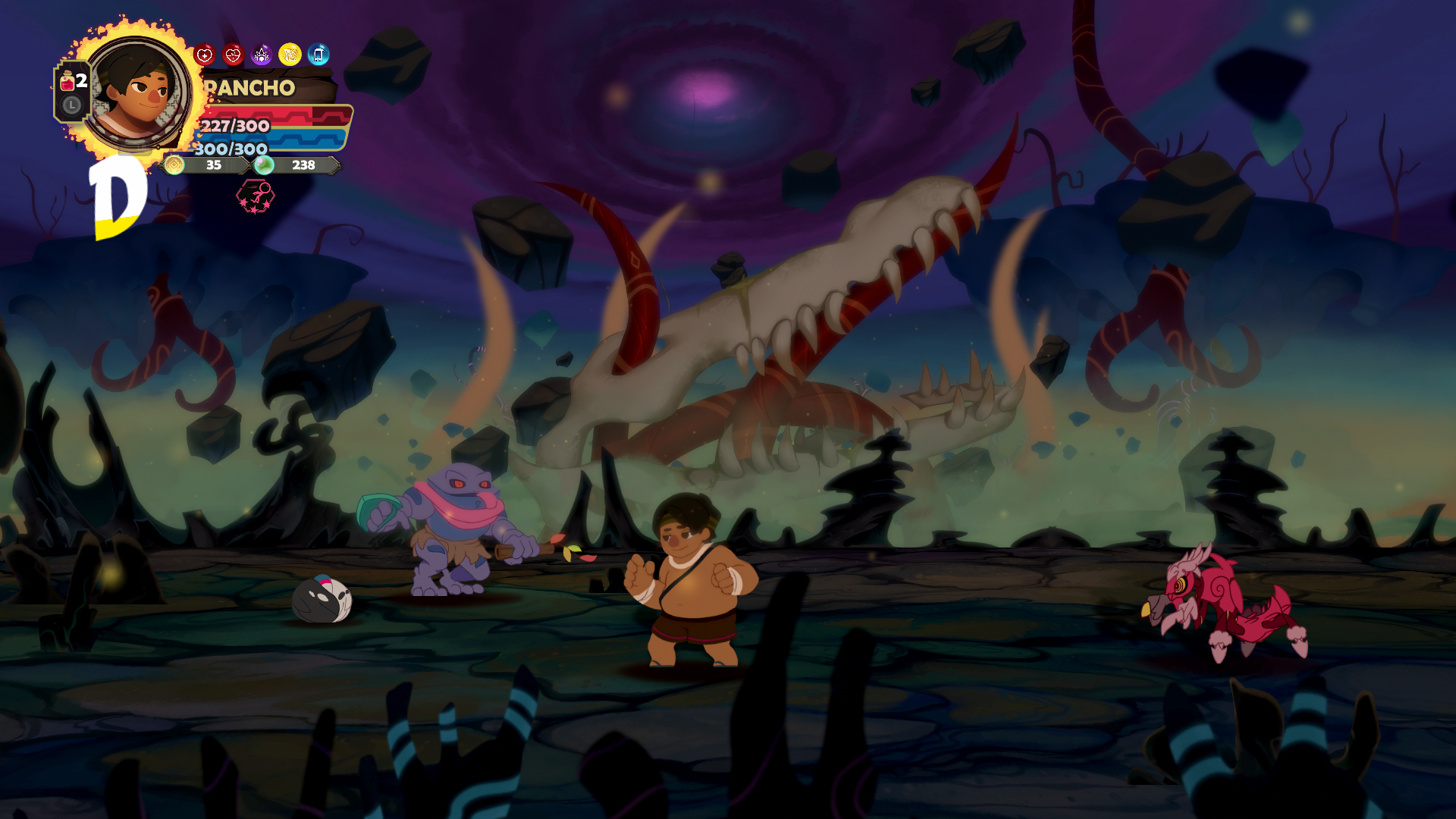
The boss fights in Tunche really stood out to me. The first encounter with each boss was exciting and packed with tension, trying my best to knock down their shield bar so I could get in some real hits and whittle away at their health bar, while at the same time trying to learn their movement patterns. I liked how most (maybe all) of the bosses are based on real-world creatures and local lore. The second boss, Boutu, is a pink dolphin, but don’t get a picture of a cute dolphin stuck in your head, this guy is vicious and probably gave me the most trouble out of all the bosses. All of the boss fights are designed well and the first time I beat each one was extremely satisfying; however, I’m starting to feel the repetitiveness after fighting the earlier ones a dozen or so times. Having some boss variety can help with the repetitiveness of roguelites, and I think that is one of the many reasons games like Binding of Isaac and Dead Cells stand out in the genre. If they could have just done something to offset the repetitive nature of the first level or two, like an alternate boss and/or level, this could have increased the long term enjoyment of the game, but based on all the movements and attack patterns I’m sure each of the five bosses in the game took a lot of time and effort to design.
One aspect of the game’s design that adds a great amount of fun and enjoyability to the game is the fact that it can be played in local co-op with up to four total players. This is a common element in the beat ‘em up genre, but I feel like some games suffer from not having enough enemies to go around for all the players. This isn’t a problem in Tunche, there are usually a lot of enemies on screen so each player can pummel enemies to their heart’s content. Only the first player unlocks achievements, which is unfortunate, and there isn’t any online co-op functionality. I think if these two issues were addressed the game could really go to the next level.
Like many of the other games I review, the art style in Tunche is what initially caught my attention. It features beautiful hand-drawn graphics. The character’s combat and movement animations really stand out, and despite the bland level layouts the backgrounds and level art are fantastic. The hand-drawn animation of some of the bosses reminded me of some of the older Disney classics from the ‘60s and ‘70s. Each character has four story sequences that can be discovered (one in each level). These are illustrated in a comic book style. I liked the presentation of this. When zoomed out they look really nice, but when it zooms in and shows each panel the artwork looks kind of blurry like it’s not high resolution. The only other aspect of the graphics that fell a little flat for me is the font they used for the dialogue boxes, for some reason I found it hard to read at the normally brisk pace that I like. The soundtrack for the game is also a nice addition to the game and fits well with the jungle atmosphere since all the tracks sound as if they would be traditional music from that area.
Conclusion
Tunche is a unique game with a wonderful aesthetic. The hand-drawn graphics really make the game stand out. The roguelite and beat ‘em up gameplay is a lot of fun, especially the combat. There is a nice variety amongst the five playable characters and playing the game in local co-op was enjoyable. The game can start to feel repetitive. This seems like the type of game where I would play a run or two, put it down, and then try again later or the next day. If you are a fan of the two genres then Tunche is definitely worth a look.

This game was reviewed based on Xbox One review code, using an Xbox One console. All of the opinions and insights here are subject to that version. Game provided by publisher.Want to keep up to date with the latest Xt reviews, Xt opinions and Xt content? Follow us on Facebook, Twitter, and YouTube.


