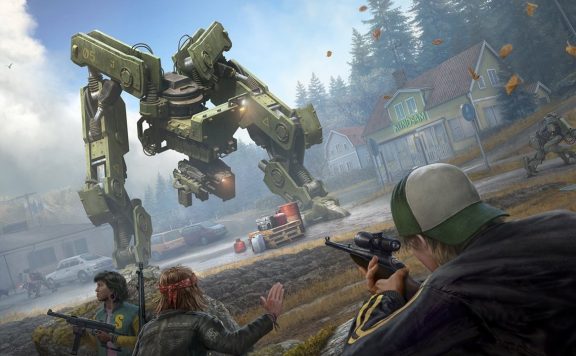
Suda51 and Grasshopper Manufacture are back with their first original game in some time, Romeo is a Dead Man. That’s not to say that players won’t immediately recognise the flow, style, and over the top action of the likes of No More Heroes and Lollipop Chainsaw though, and Romeo is a Dead Man might just be even more over the top than those games in some aspects. It’s not without its niggles, but we’ve had a great time with the game, and would certainly hold it in as high regard as those aforementioned titles.
The story – for what it is – is fun, insane b-movie schlock in all of the best ways. It’s all over the place, confusing and outrageous in equal parts, and yet we found ourselves enjoying the cutscenes all the same. Protagonist Romeo, a cop in the town of Deadford, stumbles across a body lying in the road while out on patrol. Investigating it proves to be a bad choice as the corpse reanimates and kills him, splitting his face in two. He wakes up having been saved by his time travelling grandpa, freshly remodelled with a sci-fi looking helmet, and some excellent new threads – that also include his grandpa as an animated embroidered badge on his back. Shortly, we’re whisked aboard the Last Night, the FBI’s Space-Time spaceship.
On board this vessel are Space-Time police, and we soon learn that Romeo is joining them in order to track down space-time fugitives who have evaded them until now. All of this is in search of his lost lover Juliet who may be more than she seems. As we progress, we learn how Romeo and Juliet met, and more of what happened between them that lead us to this point.
With me so far? Well, I wouldn’t blame you if that answer is a no. Like I said, it’s a fun romp but also incredibly confusing and doesn’t hesitate to veer off into tangents upon tangents with no real rhyme or reason.
But, really, we’re not expecting an actual story to rival the likes of Shakespeare here, are we?
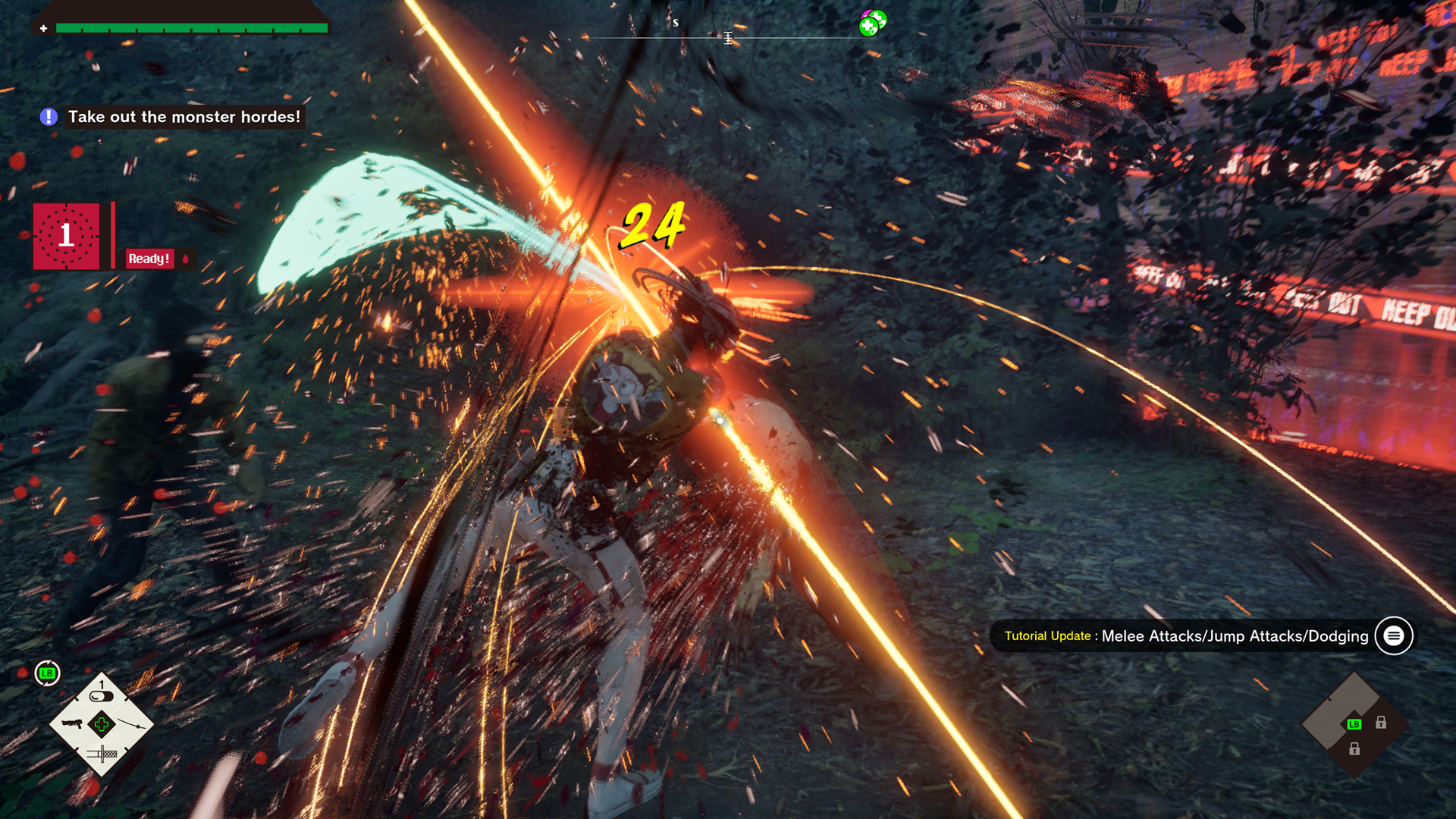
The real meat of Romeo is a Dead Man is the action, and it’s here the game shines. Romeo starts off fairly weak, with his basic chainsaw katana and pistol, but by the time we’re approaching the end of the game we’ll have access to four different melee and ranged weapons. Zombies are the meat and potato enemies here, with large hordes often bullying Romeo as we enter a new room. His movement is generally snappy, with weak and heavy attacks that can be strung together, and we quickly learn the ability to finish a heavy combo with a huge charged attack. We build up a Blood meter by attacking, and once it’s charged can unleash Bloody Summer, a screen-filling attack both on the enemies and the senses that also refills Romeo’s health slightly. Each weapon offers a unique attack, and we can eventually have three charges at once for a bit of combo insanity.
The carnage on screen is often over the top, and it can be hard to see what’s going on with blood, particles, body parts and more flying about. It is, however, never less than satisfying to play, with the rewards after the fact worth the effort. We gather Emerald Flowsion from downed enemies which acts as our currency for upgrades, shop items, and new weapons. It’s a one size fits all approach that often means – early on at least – that we need to balance what we choose to spend it on: do we need that new weapon or would a small health boost be a better fit?
The upgrade screen is about as unique as you’d expect from Suda as well. Instead of just lists and numbers, we’re presented with a Pac-Man style maze that has power ups dotted around it. Using the Flowsion, we propel a character around it in order to collect them, but can only go so far before we run out. It also creates the dilemma of which direction to go, and often we’ll end up forfeiting one upgrade in favour of others – or doubling back on ourselves, wasting Flowsion but getting otherwise inaccessible upgrades. We can reset this at any time thankfully, getting all of the Flowsion back to try again, and it’s definitely worth doing later in the game.
Boss battles provide bigger rewards, and thankfully are as OTT as ever. From our fight with a headless giant at the start of the game, through mutilated giant heads, medical abominations, and straight up demon creatures, Romeo is a Dead Man’s payoff to the levels are excellent throughout. We played on Orange Chocolate difficulty (effectively hard mode), and let us offer a word of warning: don’t. Early days it’s tough, but the second boss took us literally hours to beat thanks to being underpowered and them being able to drain our entire health bar in one or two hits. We did consider restarting at one point, but stuck it out and eventually beat it. We’re currently at the final boss and, well, this is gonna take some time we fear, but we’ll get there…
No matter which boss it is, though, they are packed with inventive designs, moves, and patterns that keep us on our toes. One boss may electrify the entire floor, forcing us on to higher ground, only to subsequently send out lasers that need to be dodged while we try and get a hit or two in. Another barrels around the arena like a deadly Sonic Spin Dash, only pausing when we’re hit or they eventually tire out. We had a blast with each one, and when we finally finished them off it was gratifying indeed.
The levels prior to these boss battles are generally pretty good, too. There are plenty of hidden areas to find and goodies to win, and the general battle flow is enjoyable enough to not really get old, even as we face yet another wave of zombies and whatever else is thrown our way. Some of the special enemies can feel a bit cheap (one covers the floor in damaging poison that makes it hard to dodge roll or jump out of) but on the whole it’s rarely too frustrating.
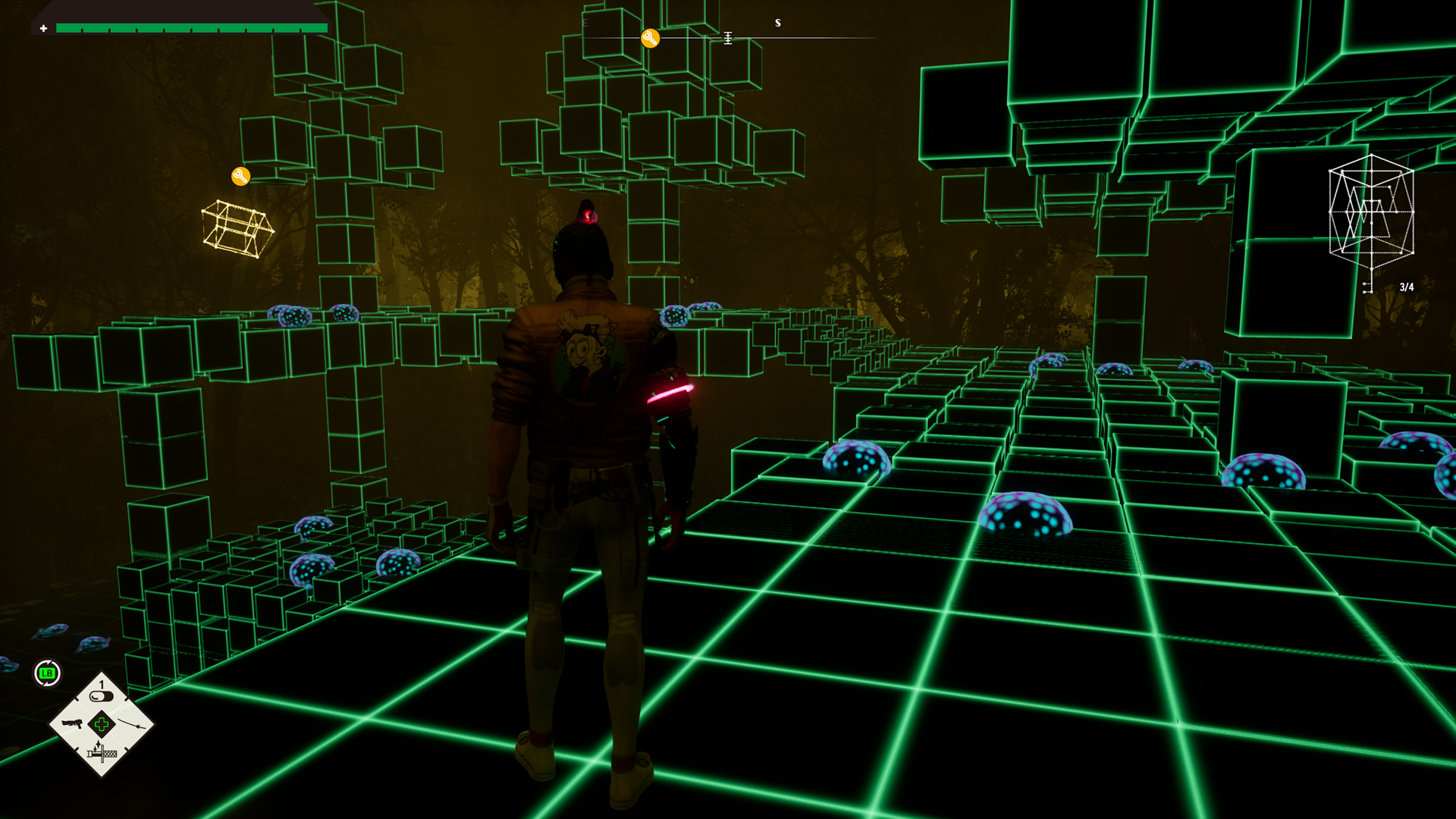
We did not, however, enjoy the Subspace parts of the game. As we approach the end of a level, we’ll find ourselves in Subspace, a combat-free zone made up of giant pixel cubes that only really come into existence as we approach. These areas are more puzzle orientated, with us needing to find parts of a Klista Gate key, often requiring going back and forth between the real world and subspace via TV sets dotted around. The Subspaces are not exactly hard, but they are a bit boring and confusing at times. One of the late game areas especially frustrated us through its layout, with a mess of to-ing and fro-ing that went on for far too long.
Adding to Romeo’s standard attacks are a cacophony of other things to consider. The key item in this regard are the Bastards: home-grown zombies that fight alongside us as powerful allies. These are gathered from downed enemies as seeds which must then be planted, grown, and plucked before use. Flowsion can be used to speed up the process, but as it’s only a ten minute wait, we’re better off using that time to do something else.

Bastards come in a variety of forms: suicide bombers, turrets, electrical, healing, and much more. Initially low levelled, we can fuse Bastards to level them up, losing the originals in the process. We can even make whole new types with the right fusions, although we found just keeping with the same types and getting them to max level was more than sufficient for the most part.
In combat, we can deploy different Bastards using LB and the face buttons. They are on a cooldown timer (based on their level) and can also be killed before they manage to take any action, so they don’t become a foolproof method of attack. They are essential, though, as they can draw enemies’ attacks and give us breathing room, or simply turn the tide of a battle if we’re pinned in a corner.
On top of this we have items that buff Romeo for a short time, badges and pins that allow him extra slots for Bastards and other items, and various mini games that can be played aboard the Last Night between missions (presented in a top down, 16-bit style), like cooking Katsu curry, trying to get a health check via a quiz, or visiting optional challenge rooms that gradually get harder and harder.
All of this adds up to quite a lot to consider when going into battle, and while it’s all worth doing, it can be a bit fiddly and laborious to get things done. For example, growing the Bastards requires several steps for each one, and none of the menus or screens load as fast as we’d like. We ended up putting on a podcast (or two) whenever we went back to do this, as the music and animations soon grew old and repetitive. The same goes for fusing the Bastards, as well as the bulk of the menus, to be honest. It’s not like we’re sitting around for ages at a time, but everything loads just slightly too slowly, making it feel a lot worse to navigate the UI than it needs to be.
We also found a few too many times in fights where we’d be stun-locked by several attacks at once, effectively one-hit killing us. Some of the early boss fights were prone to this and, having fought to whittle their life bar down for minutes at a time only to then be insta-killed by sudden attacks we had no reasonable way to avoid, it can get a bit annoying. Some of the time we can’t even see the attacks coming in, as the camera can struggle to keep up with the action. Other times, it’s just a cascading effect of one hit after another that we have no way of avoiding. Either way, it does sour the mood somewhat, and is something that we can’t even buff or upgrade our way around.
But despite these issues, we still very much enjoyed the ride of Romeo is a Dead Man. The boss battles are as good as Suda and GM have ever produced, and the general action is pretty solid and – importantly – fun enough to counter the repetition. When we do unlock upgrades they feel meaningful to the action, and as confusing as the tale may be, we still found enjoyment in the crazy twists and turns. A few nips and tucks to some of the UI and menus and we’d have an instant winner. As it is, it comes highly recommended with a few small caveats.
Conclusion
Romeo is a Dead Man is a fun, crazy, chaotic action title with a lot to offer, even if a few niggles rear their heads at times.
This game was reviewed based on Xbox S|X review code, using an Xbox S|X console. All of the opinions and insights here are subject to that version. Game provided by publisher.