Developed by Owlcat Games and published by META Publishing Pathfinder: Wotr is the giant sequel to Pathfinder: Kingmaker. Packed full of lore and story this game is a whole new adventure with plenty of customisation at your fingertips to immerse yourself into the game and play exactly how you want to.
The country of Mendev is suffering due to the worldwound: A portal that allows demons to travel to the mortal world and destroy everything around them. The mortals have fought the demons in many wars called crusades and are slowly losing ground. However, that’s where you come to try and change the fortunes of the mortals as you survive a demon attack on the city of Kenabres and find out that you have mythical powers which manifest out of a wound in your chest that magically heals itself after the power has manifested. It is up to you to lead the next crusade and fight the demons to try and destroy the worldwound once and for all.
Those familiar with the Pathfinder games know how deep the customisation can go and it’s no joke. For those dipping their toes into this series, it can be quite overwhelming. Even right at the start, there are 8 different difficulty levels to choose from which includes a custom one to tweak as you see fit. You are given a choice of 6 pre-generated characters or you can completely customise your character from scratch. This is where it is easy to get lost as there are lots of portraits of your character to choose from, and over 30 Classes of character each with different varieties of each class. For example, there are 6 types of barbarian, 7 types of rogue, and 7 types of sorcerer. After the class you still have to select a background for your character, select feats, select deity, select your alignment and then you can allocate attribute points and skill points. Once you have slogged through all that customisation you can then amend how your character looks and talks before selecting a name and birthday. Then you finally see the summary of your character to give it the once over before you can finally begin the game.
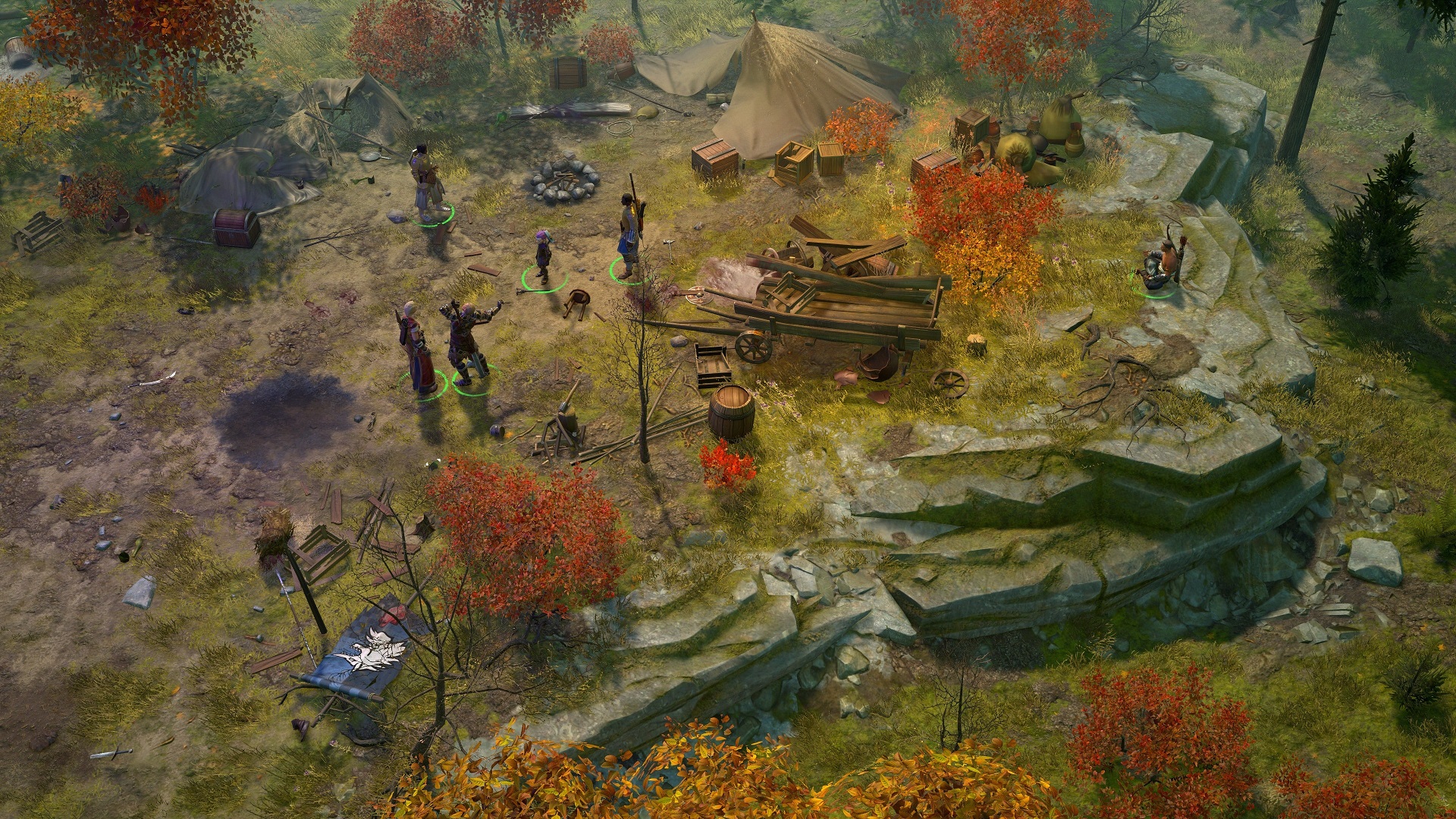
Graphically the game looks very similar to the previous Pathfinder game. That’s not to say that they are bad as they are still great, but I cannot see any noticeable differences. You still have the isometric view which is rotatable and possible to zoom in and out depending on your preference. Some of the dialogue especially with the main characters is read out loud which is a blessing as there is a lot of reading in this game which can become tiring. But if are looking to invest in the game you have to understand the story and lore is what the focus is in these games to try and immerse yourself into the experience so you will need to prepare for a lot of reading
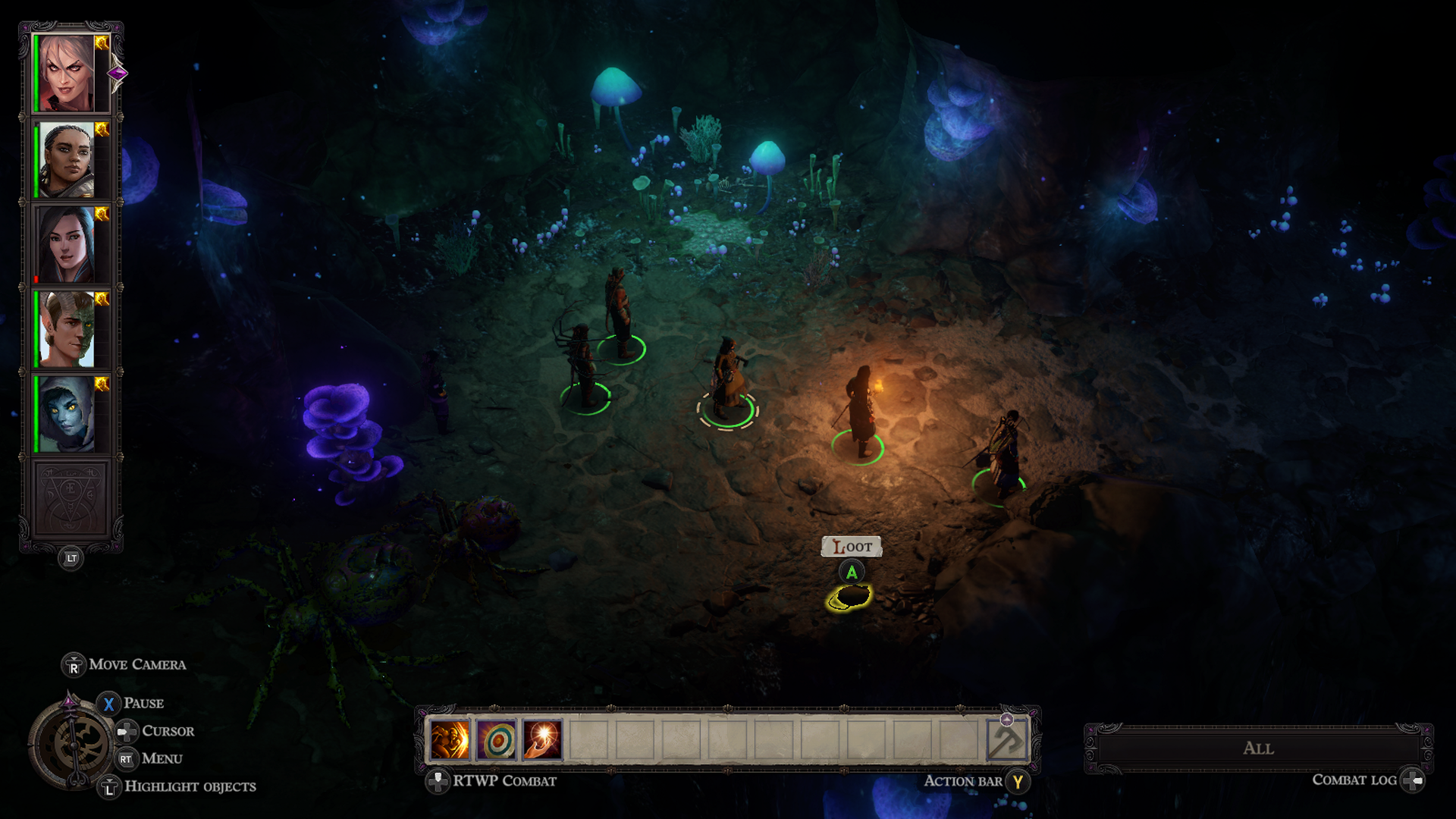
The controls can be customised much like its predecessor so that you can either move your character with the thumbstick or change to a cursor view and move the cursor to point and click your movement to different places. Each has its benefits and drawbacks and you can freely switch between them. The same applies to combat which is also a learning curve to understand. You can choose to play turn-based so the quickest characters act first with limited action points to move and perform an attack or feat. Or you can play in real-time with most of the attacks played out automatically. Once again each has its benefits with the turn-based style you can choose skills or spells to help gain an edge in battle but it is much slower. Whereas in real time you battle so much quicker but you have to rely on AI to choose the correct moves which can be risky in big battles. The good thing is you can pause to stack actions or even switch controls on the fly even during battle which is a nice touch.
There is a lot of loot and places to discover and you don’t want to just collect everything as you can easily get overburdened. There are many interesting characters that you can add to your party each with vastly different personalities and skills. As with many D&D-style games, party selection can be key to having an edge in difficult battles so it’s fun to mix things up and see what your best party is. The story is always the best part of these games as they are always so deep with many twists and turns. You think you know who the good guys are but this game will always keep you on your toes. Or maybe you want to play the bad guy and you want any goody two shoes in your party condemning your actions.
Commonly, these games are always jam-packed full of content around the story and lore and much can change depending on your actions and choices. There is one thing I didn’t enjoy and that was the tactical army battles. You get to a point in the game where you have to build armies to take on the demon army and when you move to a spot the demon army occupies, which sometimes you may have to as they block many paths, an army battle occurs. This feels very rushed and is mostly uninteresting as you are on a chess board-like grid with the armies on each side. Then you take turns trying to eliminate each other’s army until there is only one left. But sometimes even though your army level could be higher than their level it doesn’t seem to make a difference as my army seems to get wiped out pretty easily. The recruitment of new soldiers, the merging of armies, and the allocation of leaders just seem to make these uninteresting events more complex than they already are. What’s worse is if you don’t resolve this part you cannot progress the main story. Luckily you can turn the army battles off so they happen in the background but once you do this you cannot revert not that you would want to.
The only other minor gripe I have is that because this is not an Xbox Series game and just an Xbox One game that the loading screens can take a bit of time to progress. I am not surprised due to all the content involved and they do feel slightly quicker than the previous game. But part of me wishes this was an Xbox Series game so the loading screens would fly by a whole lot quicker.
Conclusion
Pathfinder: Wraith of the Righteous is a worthy sequel as it’s packed full of lore and interesting storylines. The customisation involved in the game is off the scale and allows users to tailor the experience to their own tastes. I think they could have done more to create a really simple approach for those not familiar with these games as some of the choices can become overwhelming and complex. But there are hours of exploration, story, loot, and fighting where this game delivers well.

This game was reviewed based on Xbox One review code, using an Xbox Series S|X console. All of the opinions and insights here are subject to that version. Game provided by publisher.
Want to keep up to date with the latest Xt reviews, Xt opinions and Xt content? Follow us on Facebook, Twitter, and YouTube.