With so many games coming and going in today’s gaming scene, it’s hard to keep up with everything, and harder still to keep up with smaller indie projects. Such as it was with Luto, the debut title from Brokenbird Games; a psychological horror with a twist, it should have been heavily on my radar, but alas, it slipped me by until BG reached out a little while later. I’m glad they did, as while it’s not perfect, what we have here is a game dripping in atmosphere, with genuine creeps and thrills as well as bizarre sequences that are best left unspoiled. What may look like yet another P.T. inspired affair ends up being much more, and comes strongly recommended on our end.

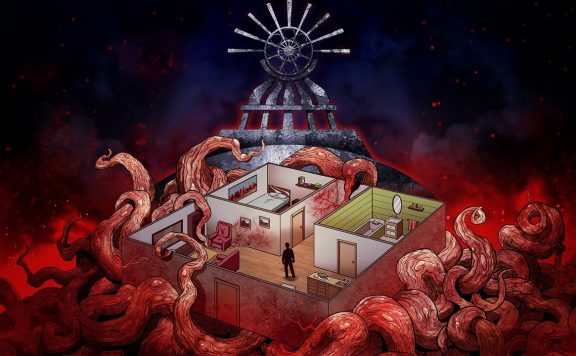
Luto is a game about death, specifically what comes after for those still here. We play as Sam as he awakes in his bathroom, staring at a broken mirror. As we leave and move through the house, it’s immediately apparent that there’s another big influence on the game: The Stanley Parable. While not as finely crafted (and certainly not as funny) as TSP, our narrator here acts as storyteller as we follow along, remarking on Sam’s seemingly rote routine each day; get up, go downstairs, get the keys, go to work, repeat.
It doesn’t take long for things to start getting weird of course, and from the time we have to return to the bathroom to find the misplaced keys through to the end of Luto, it’s one twist of our expectations after another. To spoil much would be to ruin it, but broadly speaking, the house may not be all it seems, and we may end up questioning the reality of, well, reality itself.

One thing Luto does exceptionally well is atmosphere. From our first steps to the final scene, the sense of dread and tension is excellent. Audio work is top tier, with smart use of both ambient noises, sudden effects, and positional audio. One scene in particular gave me goosebumps as I could hear something following me, although turning around showed there to be nothing (seemingly) there. Elsewhere, the game loves messing with the player in stripping audio away, or having it seemingly broken, only to blindside us. I don’t want to get into much more to save spoilers, but this aspect was easily the most consistent, and well realised aspect of Luto throughout.
It also looks stunning. It’s here the P.T. influences are most noticeable, but Unreal Engine gets put to good use, with hyper-real locations and excellent lighting. It’s all pretty static save for pre-determined animations such as billowing curtains or the frankly brilliant cloth on one particular character, but it’s still an impressive looking game throughout. It also features what I can only vaguely describe as one of the simplest yet most unsettling uses of black bars I’ve ever seen and, yeah, I’ll leave that there for you to discover.

Gameplay consists of exploration mostly, looking for items to help solve the various puzzles throughout. The areas we explore are never overly large – although later sections do get more intricate – so the solutions are generally straightforward enough to find. Not always mind you, and this is one aspect of Luto I’m still mixed on. Along the way we find sketchbook pages that act as both story fillers and puzzle hints, but there were a few times where I could not see what I was supposed to be doing at all. An early puzzle with a suspended hammer, and then a following phone number immediately come to mind. Now, it could be that I’ve just come back from a long work trip and was still a bit out of it when I started Luto, but there were a few examples later on – after I’d been back a while – where I got almost as equally confused. It’s not that the puzzles were hard per se, more that the solutions were a bit too obtuse at points, and even after consulting a guide at points I didn’t quite get how they’d got to the answer with the clues I had available. I think I probably tried to tackle one or two too early without realising – the phone number I’d figured out but hadn’t the final clue which then made me second guess myself – so perhaps a little nudge to say ‘you’re not ready for this puzzle yet’ or something might have been handy.
In the main though, Luto kept me engaged in its world, story, and puzzles enough for me to want to come back to it each night and see it through. It gets dark at times, so be warned, and its themes stick firmly in the negative space of death and mourning, but it’s also a captivating experience that had me wanting to open that door even with the threat of something sinister on the other side. As a debut game it is very impressive indeed, and whatever comes next for Brokenbird will absolutely be on my radar this time.
Conclusion
A stunningly presented psychological horror title with some excellent twists and turns that is only let down by a few obtuse puzzles, Luto is a strong debut title and easily makes its case as one of the better indie horrors in recent times.
This game was reviewed based on Xbox S|X review code, using an Xbox S|X console. All of the opinions and insights here are subject to that version. Game provided by publisher.
Head to https://www.insertcoinclothing.com/, have a browse of their fantastic range of game-inspired clothing, and when you’re ready to buy use the promo code ICXBT24 to get 10% off orders over £50 (not including charity items, bundles, gift cards or postage. All usual fair usage terms apply. It’s one use per person and valid until the end of 2025).