

Some people think that because of my previous article here, I don’t like Dark Souls, nor do I like games like Dark Souls. That is simply not true, I’ve played a lot of them and loved many of them. That said, I don’t think I love these games as much as developers Archangel Studios.
Bleak Faith: Forsaken has cribbed every note from Fromsoftware’s series. It is a third-person action game, set in a grey decaying world. There is a long and portentous monologue about an isolated anomaly, a rogue commander, and an omnistructure. Then the game starts with the player taking on the role of a morbid looking character that is having cracked memories of a conflict. Equipped with a pipe, they are expected to set out.
To be fair, it is a great opening and the world the player walks into is suitably decrepit and mysterious.
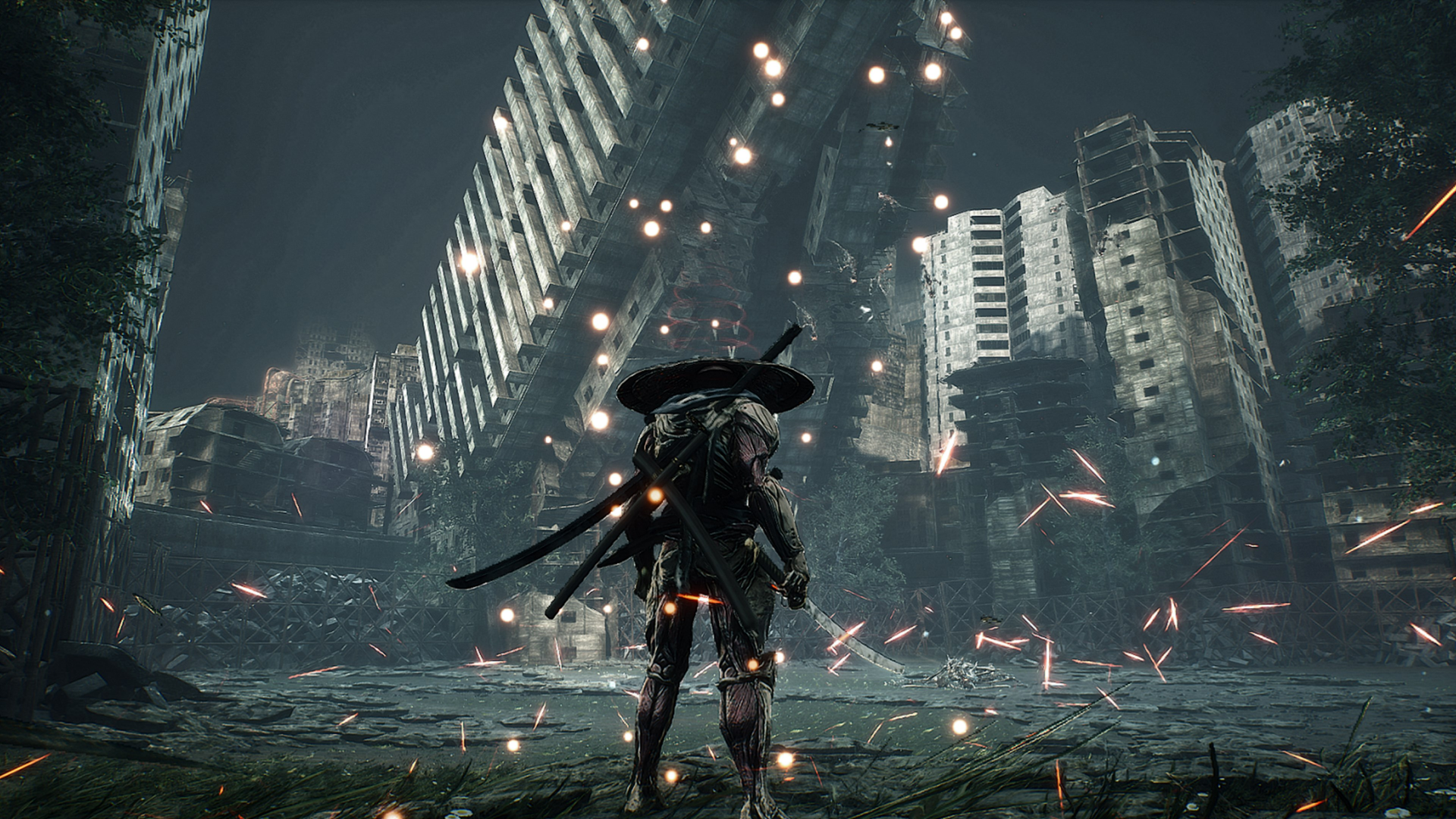
The combat is also cut from a similar cloth. There is a light attack, heavy attack (which can be charged), block (that can be timed for a parry) a dodge role and a jump. During combat, using any of these will cost stamina meter, so it is important to control the pacing of fights giving the player time to recharge. There are also magic attacks, and a range of different weapons: single-handed weapons that can used with a shield, two-handed weapons, and Great weapons.
There is an RPG system that allows for increasing specific stats (Strength, Dexterity, Intelligence and Constitution), a perk system to customise how the character plays (do more damage as your health lowers, increase the quality of magical summons etc) and then a crafting system for upgrading weapons and creating consumable buffs.
All of these will be required to stay alive in the early hours of Bleak Faith – the starting area is suitably grim, with an awe-inspiring verticality. It is the kind of grey that reminds me of the aftermath of a volcanic fallout, with black grit in every corner. The enemies are sloping automatons that lurch and swing at the player in erratic fashion. I was very taken with the visuals as I carefully wound my way down into new areas.
My enjoyment of the title ended not long after that as I grappled with the mechanics and the systems, as well as an unnerving sense of déjà vu.
For starters, the UI/UX is awful, the text is a little too small on a 50-inch screen, button icons are awkwardly pasted into sentences with visible outlines where the image was inserted. There are tutorials for combat, but those explanations feel like they need explanations.
The combat tries to surface a lot of interesting stats about each weapon where they can inflict blunt, sharp, and Technomancer (I think it is technomancer – there is just a skull symbol in the menu) damage, and so there are better suited weapons for different types of monsters. All of this would be interesting if the combat, in execution, wasn’t broken.
The starting shields and weapons only protect against a percentage of incoming damage, as well as costing stamina, so it is heavily encouraged to parry attacks and follow up with a counter. After a successful parry there is a satisfying red cloud effect that appears which in theory opens up an enemy for a powerful blow. The problem is that the counterattack is slow, some enemies are free to move as this winds up and the counterattack can miss. Worse yet, it can leave a player open for reprisal before they have time to recover. The enemy placement doesn’t help with this either. Bleak Faith loves to line up multiple enemies in a lot of areas, with there being incidents where you will have attacks coming from three different angles at a staggered pace meaning that using the parry system sets up the chance for taking more damage than simply blocking.
This means that you are going to need to suck down health potions between fights. Bleak Faith eschews the soulslike standard of having a limited amount of health potions between checkpoints and instead allows the player to craft potions at any time but are limited to only using two during combat. It is a relief that this is the case but feels like this solution was arrived at because of how bad the combat system is rather than it being a savvy tactical choice. As a result, there were times where I would swing wildly at enemies ignoring patterns and tactics, knowing I was going to chug a potion and be fine afterwards.
This led to traversal being a joyless slog of fighting identikit enemies until arriving at the boss, or midboss, that acts like brick wall. When Bleak Faith did introduce new enemies, they didn’t really alleviate the drudgery but instead caused me to hyperfocus on how much I hated fighting anything. For one example, there was a ranged character that ran away whenever I approached them, the solution was to stand stock still and parry back their ranged attacks until I whittled down their heath. For another example, there was a giant character that required me to run in and stab them in the legs until it had no health, then climb up on its back and stab it in the shoulder, then slash them in the legs again until the meter is down (again) and then stab them in the other shoulder. If you found that last sentence tedious to read, imagine having to play that sequence over and over again.
Bleak Faith fundamentally misunderstands what makes good Dark Souls combat – when you encounter an enemy for the first time, it is really difficult, and a mistake might reduce you to zero health. However, once the trick to beating them is learned most enemies go down quickly.
Bleak Faith posits the idea that fun is to make every enemy encounter a long drawn out back and forth even when you know the trick to beating them.
I think the devs also thought it would be fun to have plenty of items to pick up and equip, a way, perhaps, to give the player options on how to engage opponents. I just wanted an item that made the fights more interesting, or shorter.
Maybe it was this endless repetition through these fights that made me start to scrutinise the environment art and enemy assets. For the former there was an incongruity in quality – something looked detailed and then other parts looked like Unreal Engine was still loading in the textures. The enemies, and definitely some of the equippable items, had a strange familiarity that I could not shake off.
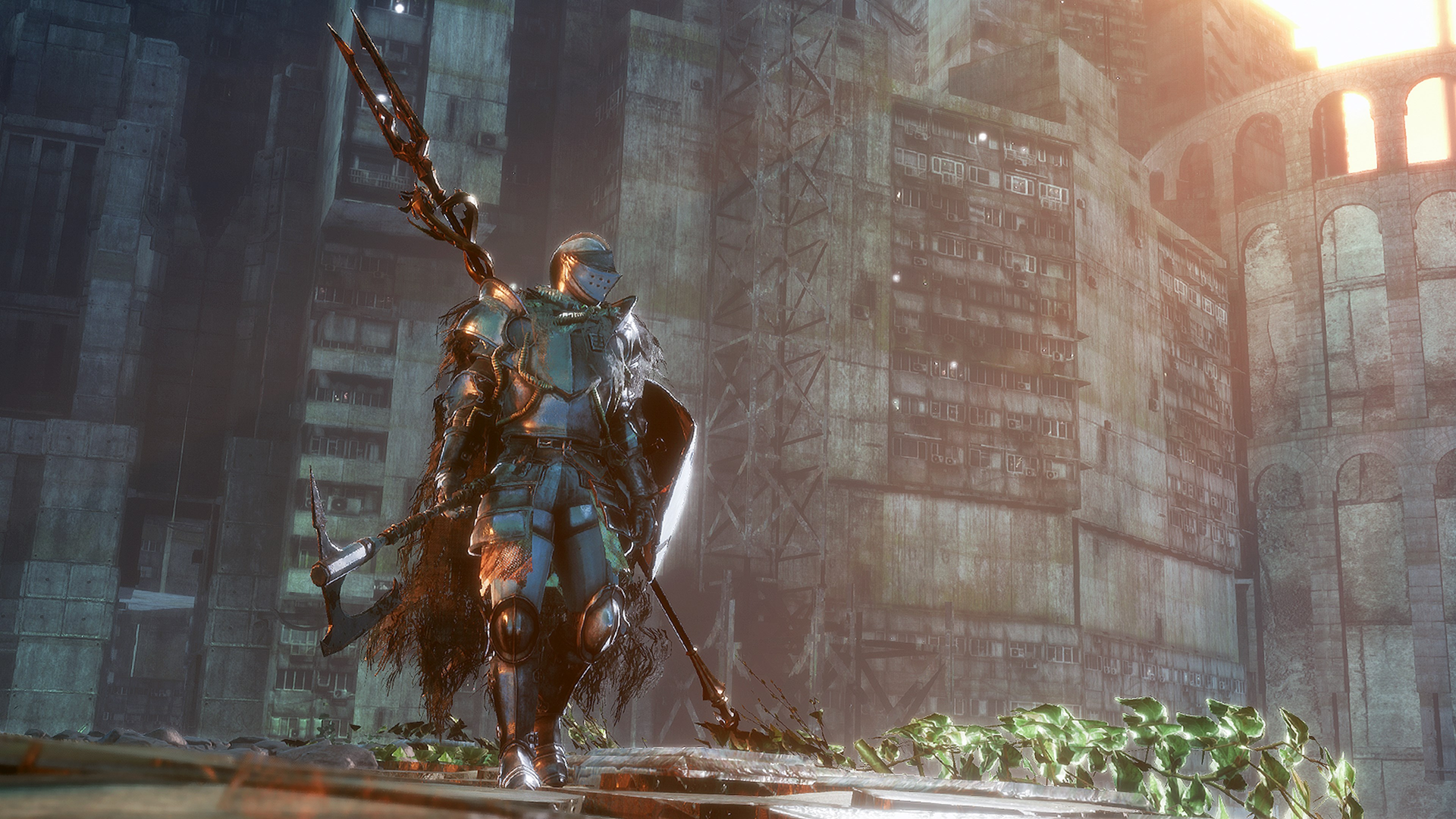
So, I had to do a quick google of ‘Bleak Faith’ and ‘Plagiarism’ and it surfaced this article on the three man development team having potentially stolen assets from Elden Ring. This is an accusation that developer ubermensch42 has denied and I believe them. It is much more likely that they purchased these assets from the Epic marketplace and simply didn’t know that they were ripped off from another game. They have since removed the offending articles.
That said, there are still a lot of assets in there that look exactly like they are from other games.
All of this combines to make me feel deeply cynical about Bleak Faith: Forsaken. I wish this was a story of a small indie dev batting above their weight and producing a work of flawed inspiration, instead the story just seems to be of a flawed piece.
Also, who calls themselves Übermensch?
Conclusion
Bleak Faith: Forsaken starts out incredibly strong with its visuals and architecture. It is unable to back up this initial promise with engaging combat, or game design.
This game was reviewed based on Xbox S|X review code, using an Xbox S|X console. All of the opinions and insights here are subject to that version. Game provided by publisher.



Peter Russell
After reading this, I’m very much glad I didn’t pick it up!
badgercommander
It is a pretty miserable experience. There is a part of me that would love to play it with all of the enemies in the game removed, as the world is interesting