Akatori is the first game on XBOX from developer Contrast Games. It’s a throwback to no-frills platformers that won’t take you too long to beat on the easiest setting but also allows you to turn it into a punishing platformer if that’s more of what you’re looking for. Let’s double jump in.
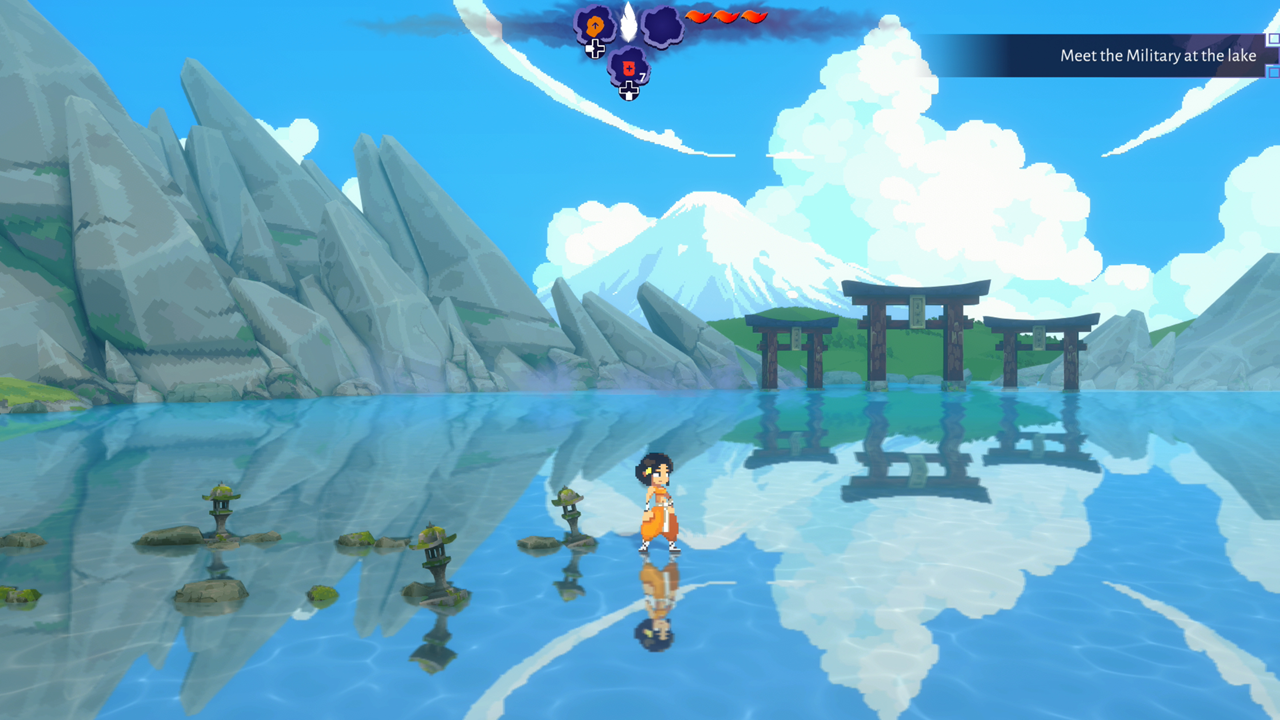
You play as Mako, a monk, and you are tasked with leading a group of military scientists to the nearby temple as they search for a way to stop the amber storms that are destroying and corrupting nature. While searching the temple to help the scientists, you find and free a captive bird-god named Akatori who guides you towards ending the amber storms. Even though Akatori can be beaten in a few hours on the easiest difficulty, they try to pack a few twists and turns to the story. If you’re not a fan of exposition, don’t care for the story, or are replaying the game, you can skip most cut-scenes and conversations by holding down the A button.
The game is a beautiful pixel-art platformer and will have you travelling through a few different biomes. You start out in the monk’s monastery, but you’ll also progress through mines, a forest, a castle, and a factory. You move with the left analog stick and can pan the camera around using the right analog stick, which is handy when planning your next jump. I often like to use the d-pad when it comes to precision platformers, but Akatori doesn’t require that level of control. Instead, the d-pad is used to allow you to assign different potions for quick access. For the most part the game controls well but I should mention that the mechanics around grabbing onto bamboo poles is a bit touchy especially when you are fending off flying enemies and/or projectiles.
There are four save slots, and when you start a new game, you are asked to pick a difficulty level. The difficulty cannot be changed mid-game so if you find it too easy or too tough, you’ll need to start a new game. I typically play games on normal (what they label Confrontation) but I found from trial and error that Story difficulty gave me enough of a challenge without being too punishing. If you are hardcore or have mastered the other difficulty levels, you can choose the highest level of difficulty called One Chance where you take more damage and if you die, your only option is to return to the main menu.
While a platformer, the game also incorporates rogue-lite mechanics like unlocking shortcuts and pushing your luck. There are cairns that serve as checkpoints when you run past them, but can also be used to refresh your health. If you use the cairn to refill your health, enemies respawn and you lose all of the chaos you’ve been collecting from killing enemies. This chaos can be used to unlock Chaos Arenas which, when beaten, will reward you with a new power or another life bar. As soon as you find a Chaos Arena, I recommend that you find a way to farm the chaos necessary to unlock it as soon as possible as they’ll make the combat more enjoyable or provide abilities to progress to new areas.
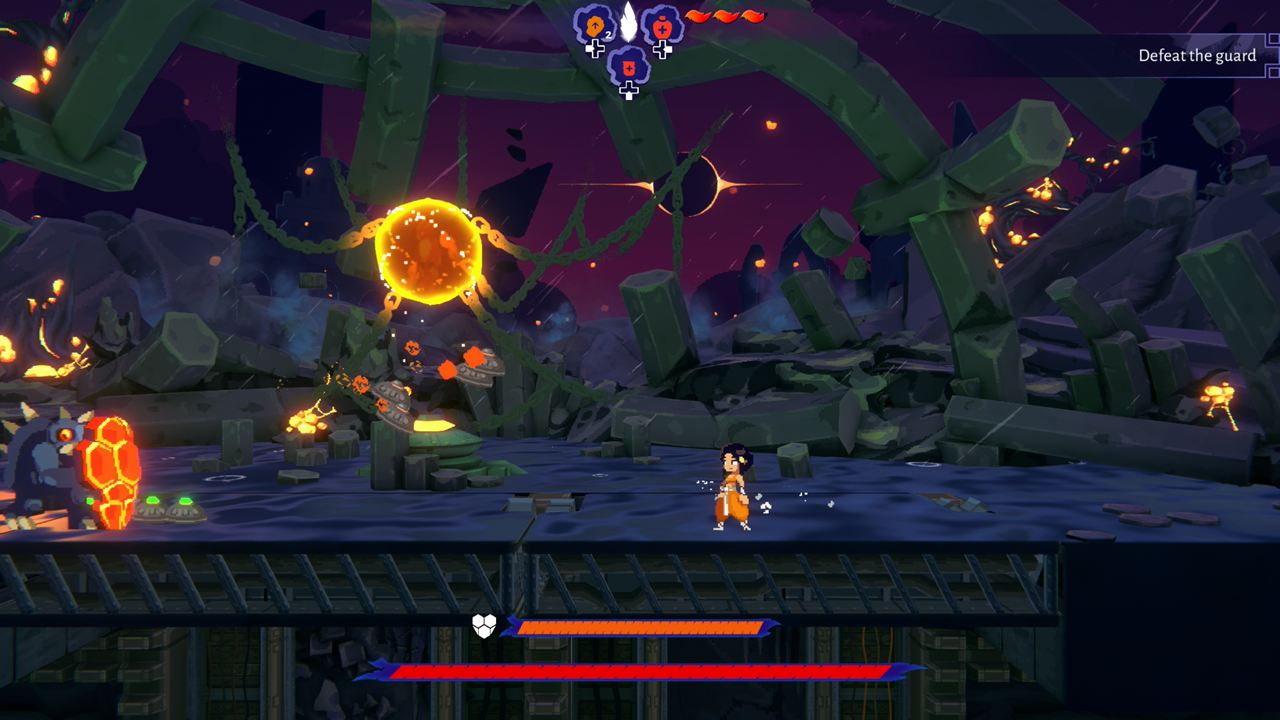
The combat evolves as you/Akatori power up and gain new abilities. At first you start out punching or swinging at enemies, but before long those new abilities will give you new options. Most projectiles can be reflected with a well-timed attack. You can throw and recall your staff to stun enemies. Later on you’ll be able to use the same move to pull distant enemies closer to you. You can launch enemies with an upper-cut or use your slam move to send out shockwaves when you crash to the floor. Yet, sometimes you’ll find yourself taking less damage by just running through an area and avoiding conflict especially when you don’t need to farm chaos.
The game has one type of collectible in the form of twenty cat statues. Some of the statues are hidden behind secret walls or are in hard-to-reach areas but you will almost always hear an audio clue when you happen to be close to one. Be warned, if you are the type of person who has to catch them all, you will want to find a way to the first obvious cat statue before you enter the nearby temple, as story reasons will prevent you from returning to that area of the monastery later in the game.
Conclusion
I had a good time with Akatori and found it to be the perfect palette cleanser between larger games. The platforming, combat, and exploration were well done and I found the pacing and length of the game to be just what I was looking for.
This game was reviewed based on Xbox S|X review code, using an Xbox S|X console. All of the opinions and insights here are subject to that version. Game provided by publisher.