I’m old enough to remember the original releases of WWF No Mercy and Wrestlemania 2000 on the N64 (hell, I’m old enough to remember the WCW titles too, but we won’t go there). They were revolutionary for the time, with fun, simple arcade-style action that still let us live out our Sports Entertainment fantasies with well-realised renditions of our favourite WWF superstars. Each move felt impactful and brutal, but there was an element of free-form chaos too in the way moves might end up hitting others in unexpected ways.
We’ve obviously come a long way since then, and developer Yukes have since passed the baton on to 2K’s Visual Concepts. Their first outing was, to put it mildly, utter shite, but they have since redeemed themselves with the excellent 2K22 and 2K23 titles. Yukes have been quietly working away on a new pro-wrestling game though, and here we are with the result – AEW: Fight Forever. While their latter career on the WWE titles leant more into an almost simulation approach at times, with Fight Forever they’ve gone back to the aforementioned N64-style of wrestling games – for better and worse.
Fight Forever feels a bit bare bones compared to the more mature and fleshed out WWE games, though I for one kinda dig it. In terms of match types we’ve got the standard 1/2/3/4v1/2/3/4 that come with a few stipulations (such as Lights Out or Falls Count Anywhere), but also a handful of specialty matches: Casino Battle Royale, Exploding Barbed Wire Death Match, and Ladder Match. These are obviously the bigger draw and offer more to sink our teeth into. The Barbed Wire Death Match is surprisingly well done as well, with a timer counting down to a meaty explosion that’ll damage those near it significantly. And yes, it is possible to unlock an easter egg version of this that replicates the woefully done real life outcome between Mox and Omega.
Outside of these match types, we’ve also got a selection of crazy mini-games, with a few examples being the likes of a AEW Pop Quiz, a rhythm-based dance off, Baseball, and a spot the difference with real-life stills of AEW action. These are…quite odd to say the least, but at the same time imbue that sense of humour that was found in Yukes’ older titles. The Baseball one got a chuckle out of me especially, as those pitching the ball are actually slingshot-ing their tag partner who has a giant baseball for a head!
These can be played as is, either against AI or human opponents, but they also feature in the short career mode – Road to Elite. This mode has us follow the life of a wrestler over a year as they begin their journey in AEW all the way up to getting a spot at their biggest PPV Double or Nothing. This year only takes a matter of hours though, and is built for replayability. Each chapter is broken up into blocks, and these are semi-random depending on how we perform in matches or who we’re in a program with at the time.
As well as the expected wrestling and the mini-games, we need to engage our athlete in order to make sure they’re prepared for their next big match. Each block is broken into four weeks, and each week is broken into four turns. With these turns, we can choose to train and earn skill points and currency, go sight-seeing or host press conferences to boost our morale, or eat at a restaurant to regain energy. While I appreciate the attempt at giving us a glimpse being the curtain of the wrestlers travels, it did feel a tad redundant to have all these extra systems in place at times. The only time I went into a match with less than 100% energy was on my first turn when I didn’t really know what was going on, and although there are some funny in-jokes and gags to find in the writing when doing an activity, towards the end of the career I found myself more keen to just get back to the grapps than read another dad-joke level pun from one of the waitresses or superstars we meet.
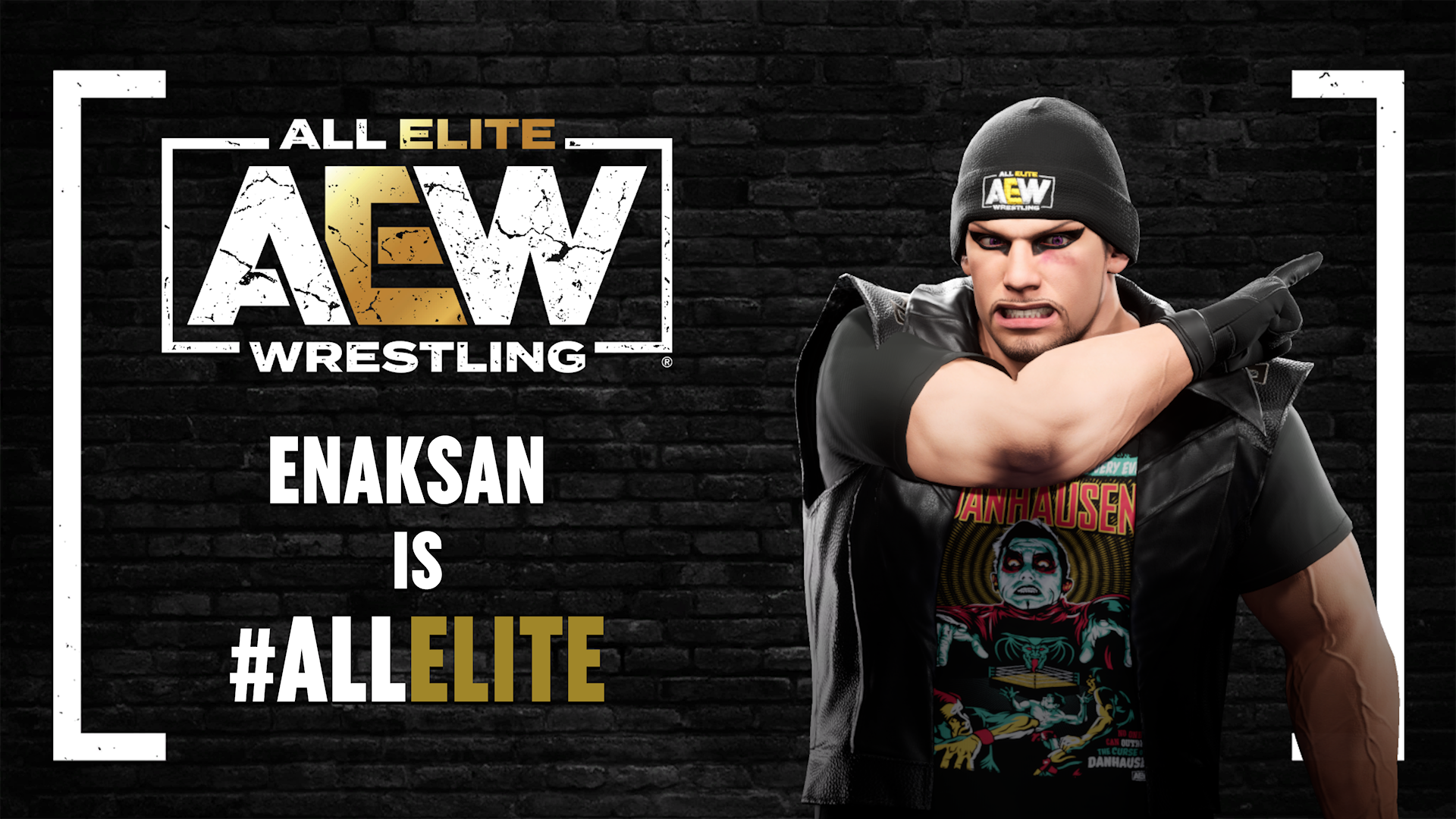
This was a pretty cool touch once I’d finished making my character 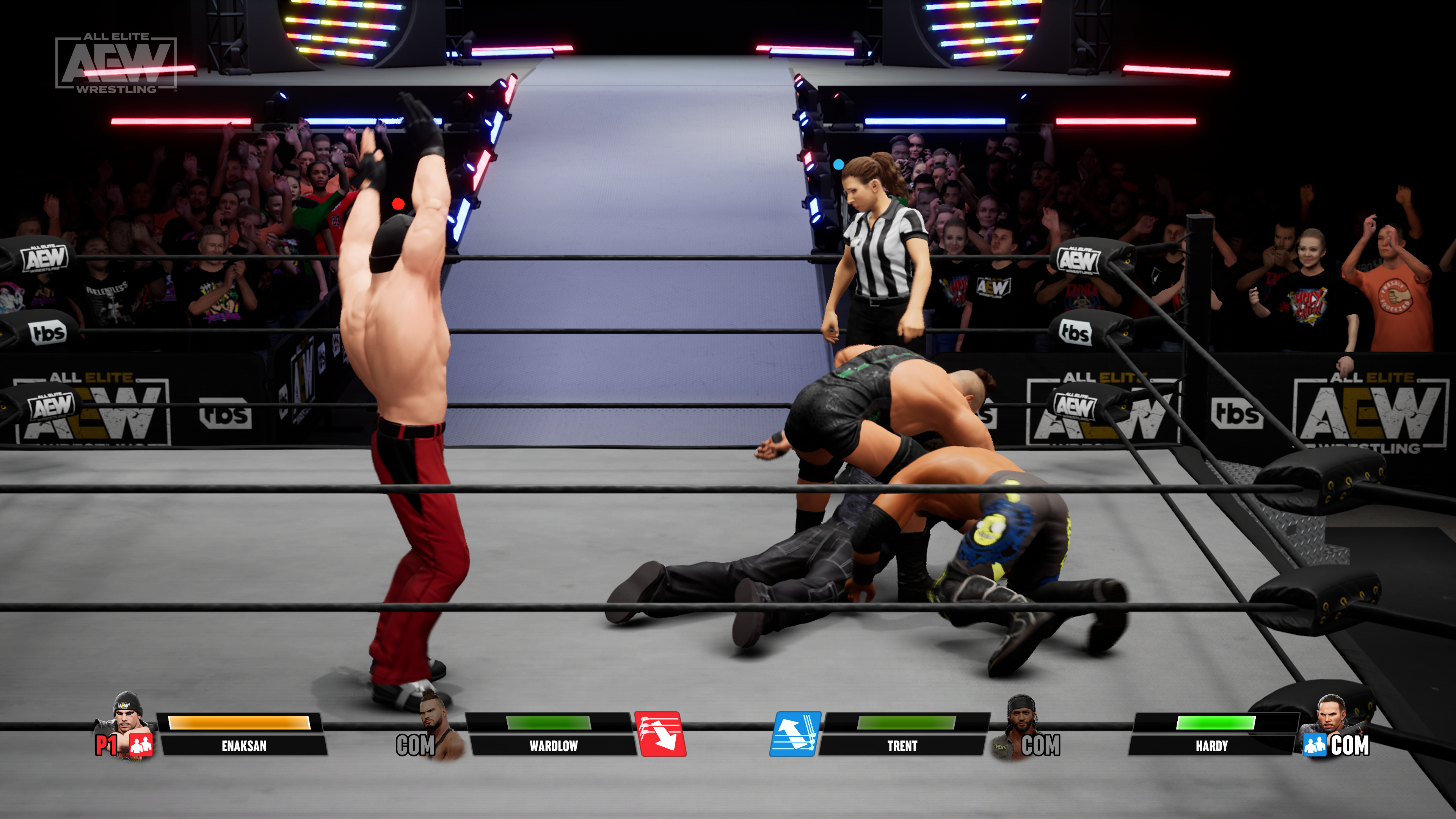
The taunt might be familiar to fans of a certain super saiyain anime… 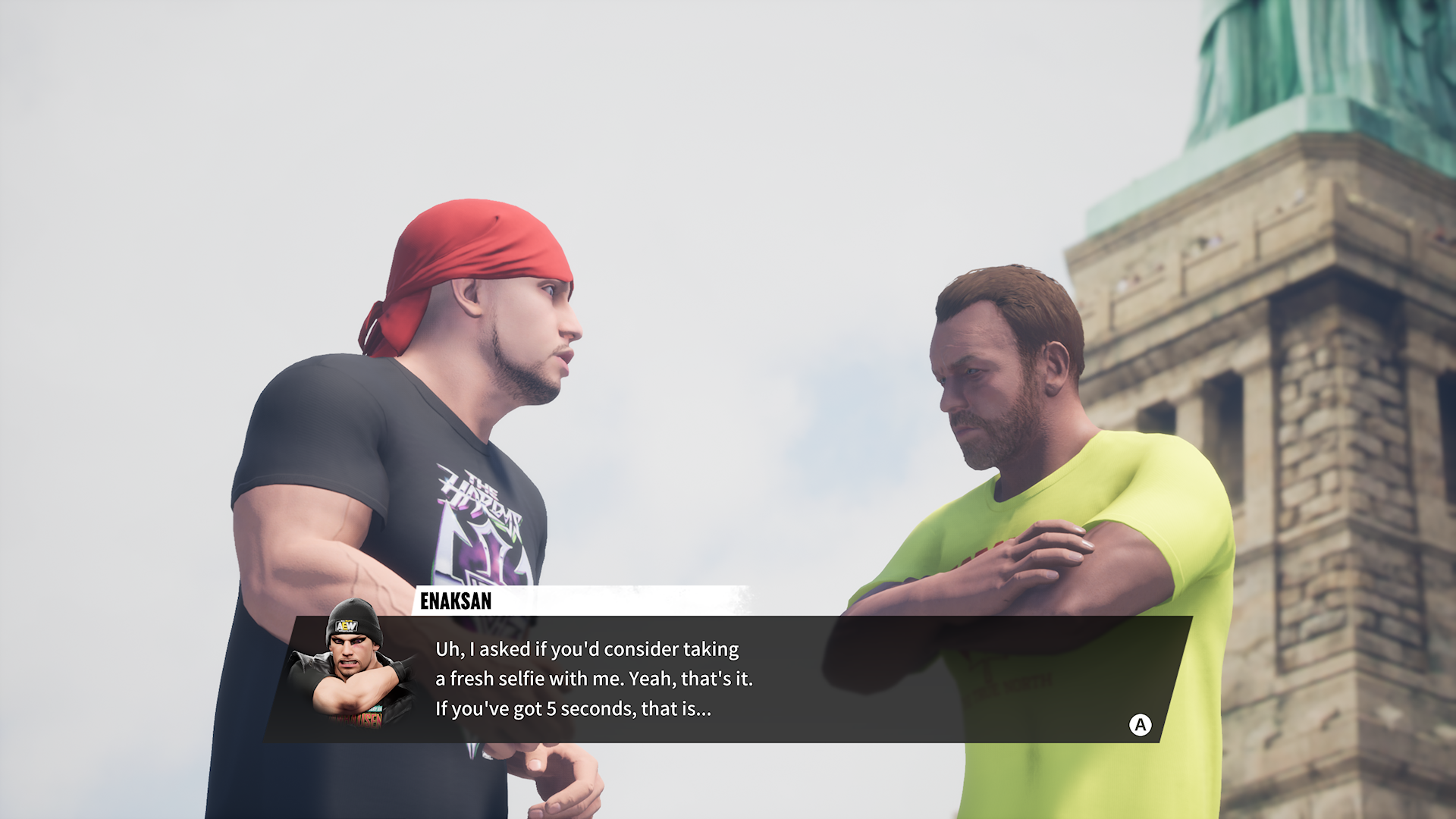
While the jokes can be cheesy, there are a good amount of nods to wrestlers real life past
Before we get into the actual wrestling action though, I must mention the custom wrestler mode. This is always one of the first stops when getting a new wrestling game, ready to build out the latest version of our custom wrestler and see what’s possible. In Fight Forever, we’re given an impressive suite of options to choose from, with plenty of looks and moves to wade through. We’ll need to unlock more finisher and special spots with upgrades, as well as increase various other stats by going through Road to Elite, and once done can come back into the editor at any time to add or change anything we’re not keen on. There doesn’t appear to be a way to share creations yet, but I imagine there’ll be a thriving online community sharing builds for all sorts of wrestlers soon enough.
So, onto the wrestling then, and, well, it’s complicated. Not in terms of inputs, but in terms of what to expect going in. On the one hand, olds like me slipped right back into our N64 days, working my way the quirks of the physics and slightly wonky collision detection. However, if you’re used to the more recent WWE games then this might be a bit of an unwelcome learning curve.
Interacting is simple enough. We’ve got a punch, kick, and grapple, and holding any of these does a stronger version. Within a grapple we can use a direction and one of the buttons in combination to pull off one of our moves, depending on context (front, back, ground, ropes etc). So far, so good. Counters are assigned to the bumpers – left for grabs, right for punches – and we’re able to get in and out of the ring and climb turnbuckles with a pull of LT.
This all results in the same feel as those games of old, and means technically even complete wrestling noobs can get in and be pulling off all sorts of pro moves in a matter of minutes. The gameplay feels a tad faster than I remember the N64 games being, though that machine generally output games at about 3fps on our slower PAL 50hz systems anyway, so it could just be the technology finally letting me experience it as it was intended.
Yukes pull out some neat visual touches too, with quick shot camera cuts for high impact moves, and the wrestlers do a great job of selling the pain with some nicely crafted recovery animations.
All of the above is pretty great in a 1v1 scenario, but add a few more opponents and the cracks start to show.
I’ll preface this with the note that I’ve only played against the AI so far. A IRL meet-up isn’t on the cards for a while and though there’s online play I’ve just not been able to check it out as of yet due to not being able to find an opponent.
As I was saying, as soon as there are more than 2 participants it begins to devolve from manageably clunky to – at times – simply broken. On the lighter end, the physics system in place means it’s possible to constantly get our move interrupted by the other guys swinging fists too near us and hitting one (or both) of us. It can lead to hilarity, and for me was the least of the concern, but after a while it pays to try and get as much distance between fighting pairs as possible.
Slightly more annoying is movement around the squared circle. When there’s room it’s fine if a bit stilted. When there’s more players, or even if someone is laying down, it becomes an exercise in frustration as we bump into each other or, in the case of the latter, potentially block us from exiting the ring or climbing the turnbuckle. I’ve always used Jeff Hardy’s Swanton Bomb as my finish, which requires a corner climb. But if the opponent is down even remotely close to the corner and laying in the wrong orientation, when I run to jump over them if sends me off in the wrong direction. I can go around them, sure, but because this is still fairly slow they’ve usually recovered by the time I’m up there, rendering my move useless.
This stilted movement also hampers run ins to save a tag partner in a pin or submission. It seems the AI especially gets caught here. One example was a tag match I had with Darby Allen. I was pinning one opposing wrestler, and so both he and the opposing tag partner jumped in. Darby ran straight at them and swung, only to completely miss as me and my foe were in between the two, which let the other wrestler break to pin uncontested. Once gave it a bit of a showmanship feel, but by the time of the sixth pin attempt it began to grate. What doesn’t help is that the ref is just as stilted – on more than one occasion I’d counted to at least 2 before they’d even got down on the mat to start the count.
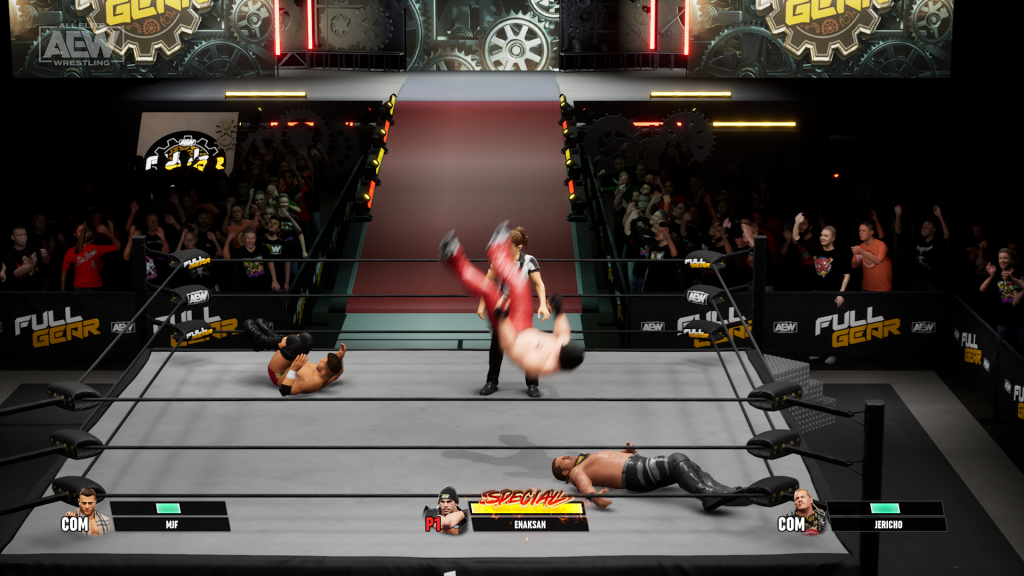
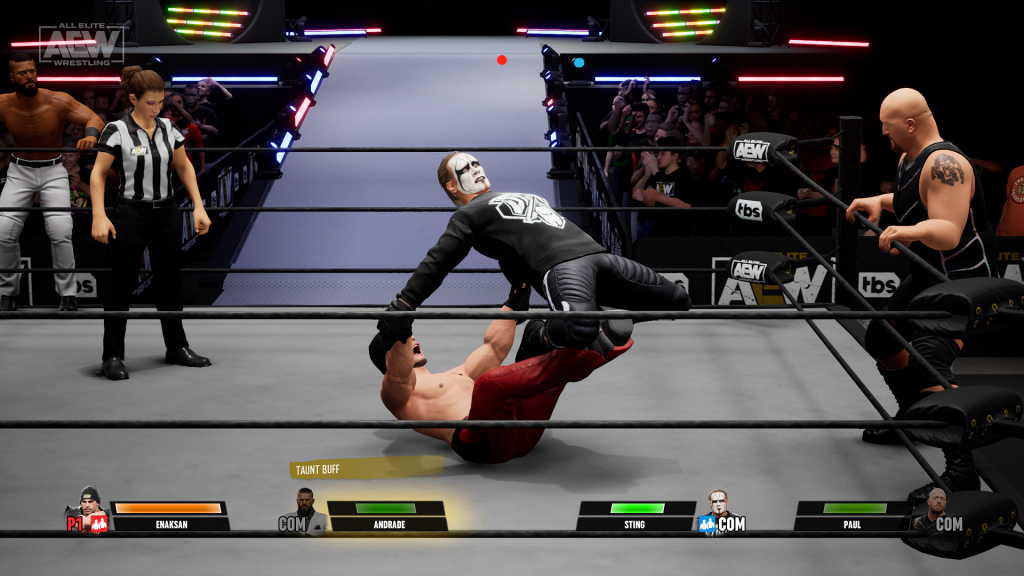
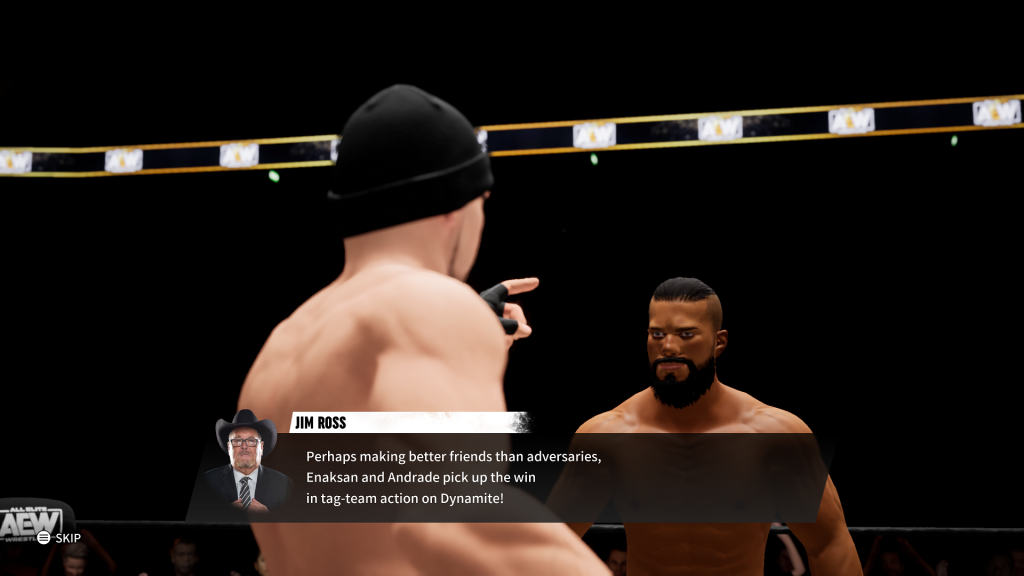
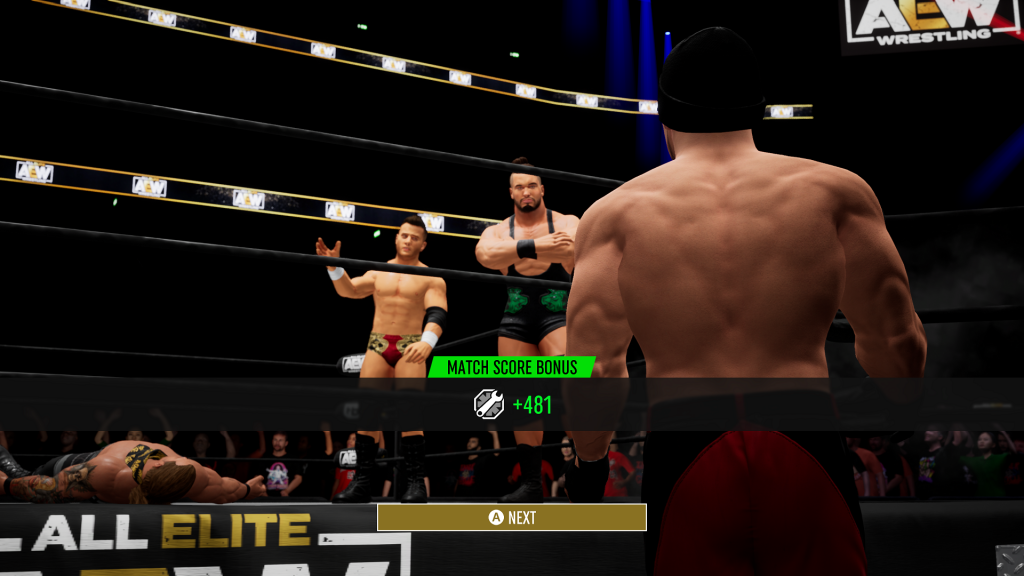
There are other more egregious issues that rear their head too, especially in the tag team setting. Tagging in the AI partner sees us given about ten seconds to help them before we’re forced to the outside. We can interrupt at any time which also brings in the other teams partner too, but the game seems to randomly decide when we can control our character and the AI taking over for us. When this happened it was a guess as to whether they’d keep fighting, return to the corner, or just stand there stuck to the spot for a while. We also then are at the mercy of our AI partner as to when they tag us back in, which might well be minutes later, if at all.
Using weapons or climbing a ladder are equally clunky, and make the stand out modes and mini games that use them more hassle than they need to be.
On a slightly less pressing issue, there’s a lack of pizazz when it comes to the presentation. The visuals are good enough, all slightly exaggerated features and plenty of colour and movement. But the entrances are boiled down to a few seconds of seeing a wrestler at the top of a ramp, some doing a basic motion, before we move to the ring. There’s a plethora of backing tracks to listen to throughout, but no commentary. The only time we hear JR, Excalibur and a handful of others are in small snippets in story mode or the tutorials that pop up. Although, it may be for the best as JR and Taz appear to have recorded their lines after waking up in an underground tunnel.
Despite these issues, I still found the fun in most of the matches I’ve played so far, but it feels far more like me leaning on some nostalgia than I should be. When the wrestling works it has a far meatier feel than the WWE games or recent memory, and I do appreciate the return of the Momentum meter. This dictates when we can use our Special and Finishing moves based on how well we’re performing, and comes and goes with the flow of the match. It’s entirely possible to gain a finisher quickly through a quick beat down, only to lose it before we get a chance to use it due to the opponent making a bit of a comeback. This lets matches have a more ‘realistic’ feel, like the ebb and flow of a regular Dynamite show.
Finally, the roster is a mix bag in terms of who’s here. We get the big names – CM Punk, The Elite, Adam Cole etc – and some of the wider roster, but there’s a distinct lack of The Acclaimed, Keith Lee, FTR and more. Some of these are coming in future DLC packs at least, but it does mean there’s a good chance one of your favourites might not have made the cut.
Conclusion
When Yukes and Kenny Omega stated they were looking to bring back the glory days of N64 wrestling titles I was on-board. As a fellow student of those times, there’s a clunky charm to AEW: Fight Forever with its meaty feeling moves and arcade-style action. However, those days were far longer ago than I care to think about, and younger players will have gotten used to a more fluid and fully featured sports entertainment game. If you can work around some of the more pressing quirks there’s fun to be had here, but this feels more like a base to build off of for the hopeful sequel down the line.
This game was reviewed based on Xbox S|X review code, using an Xbox S|X console. All of the opinions and insights here are subject to that version. Game provided by publisher.