Puzzle games will always grab my attention, and while I’ve played a lot of examples of the genre, ones involving rolling a ball around a level always seem to rise to the top of the queue in my eyes. Orbyss then immediately hit my must play list, and thankfully it has proven to be a great example of the puzzle genre.
The concept is simple; roll a ball, hit switches, use lifts, and get to the next area. Things start off simple, and the opening few levels of Orbyss are a nice on-ramp of gradual difficulty. Using a controller (or in this case, the ROG Xbox Ally X), movement feels fluid and controllable, the ball having just the right amount of physics momentum without making it a Super Monkey Ball-like affair.

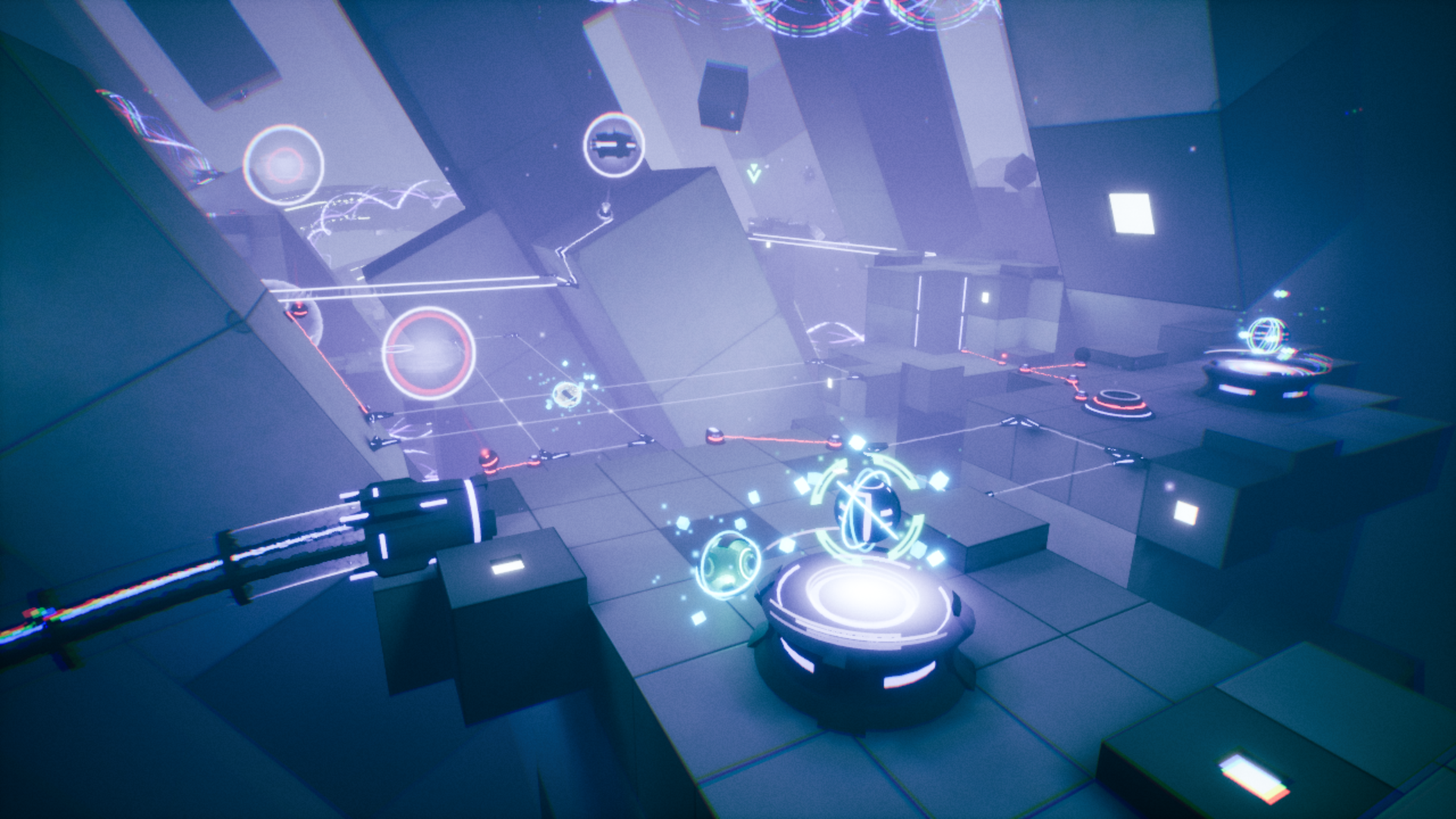
It’s not long until we’re introduced to new concepts, from being able to drag and order about a second – or third – ball, to switching between balls in order to rapidly hit switches, or even being able to stop and start time to freeze balls in place.
Each of the 8 chapters offers new mechanics to okay with, and makes smart use of them to create ever more challenging scenarios. By the time we’re towards the end we’re using route-tracing ships to move balls while matching audio cues to open teleporters…it sounds complicated but in practice Orbyss does a good job of always keeping our focus on the task at hand.
Levels are split into rooms, and each room contains a small puzzle that, although occasionally complex, is never overly large as to be off-putting. It’s always easy enough to see what to do, even if the how takes a bit of time.
There are even extra challenges for those who are willing, such as completing a ball-swap puzzle without actually swapping balls. I tried this first example for a while, but had to move on for the sake of battery life, though I almost had it, I’m sure. These are mainly tied to achievements, and are completely optional, but are a nice addition if you think you’re blasting through the game a bit too fast.
We also have access to a hint system, though I did find this a bit underwhelming in practice. One puzzle had me stumped, and though I could see the idea, I couldn’t grasp one aspect of it. I chose to use the hint and the only thing it would tell me was something I’d already figured out. It would have been nice to be able to have a few hints to show a bit more rather than just the one.
But to be honest, this was the only time I used it as, for the most part, Orbyss is a decently balanced game in terms of difficulty. At only a few hours long, it’s not going to test us for weeks on end, but I much prefer a shorter puzzler like this that makes good on an idea over a couple of hours and knows when to call it, rather than pad it out for the sake of runtime.
Conclusion
Orbyss proves less is more, with a snappy runtime filled with decently balanced puzzles and continuous new ideas to keep things fresh. A slightly more robust hint system would be great for when players need it, but otherwise Orbyss comes with a hearty recommendation if you’re in the market for a few evenings of puzzle goodness.
This game was tested and reviewed on PC (via Steam). All of the opinions and insights here are subject to that version. Game provided by the publisher.Want to keep up to date with the latest Xt reviews, Xt opinions and Xt content? Follow us on Facebook, Twitter, and YouTube.